We can have democracy in this country, or we can have great wealth concentrated in the hands of a few, but we can’t have both.
– Supreme Court Justice Louis Brandeis
The stock market wobbled in the summer of 1929. Apart from a tongue-lashing given by President Hoover to a NYSE exec on the dangers of speculation, per the prescription of the economists who had Hoover’s ear, the sum total administrative response was to trim individual and corporate tax rates.1 When the DJIA plunged precipitously in October, Wall Street’s leading cheerleaders, including Princeton’s Joseph Stagg Lawrence, quietly folded up their tents and slid into obscurity.
The economic chasm that opened before the nation was as awesome as the recently established Grand Canyon National Park and at times became as existentially frightful as the Civil War. There was no TARP waiting in the wings to catch America’s teetering big businesses. Behemoth trusts, many of them highly leveraged and deeply intertwined, fell like dominoes. Coupled with the collapse of tens of thousands of SMBs, it was like an economic atom bomb detonated.
The collateral damage was spectacular. GNP plunged 30%. Roughly 90% of the NYSE value evaporated.2 A $10,000 investment in a DJIA index fund in late ’29 was worth $1,400 by late ’32.3 Only a dozen mutual funds survived the Great Depression.4 The unemployment rate quickly spiked to around 25%. #Progpop era torches and pitchforks were dusted off and raised anew.
President Hoover’s cabinet, comprised of wealthy businessmen like himself, had an abiding faith in laissez-faire norms. Hoover was born to a family of Quakers who ran a farm equipment store in Iowa. He attended Stanford and went on to amass a multimillion-dollar fortune by the time he was 40 – over $100 million today – by purchasing distressed mining operations and either getting them back on a track to profitability or selling off for spare parts.5 The young Hoover was a brilliant financier or a pioneering corporate raider in the vein of Wall Street’s Gordon Gekko, depending on how the transaction played out and which side of it you were on, and his preference was for government to stay at arm’s length from business affairs. Now in the oval office, he and his cabinet were convinced this downturn would be no worse than the ’21 recession.
Hoover, interestingly, had boomeranged on laissez-faire. He was in London plying his trade when World War I broke out. The Wilson administration approached him to help get Americans out of Europe and to distribute aid to those who couldn’t or wouldn’t leave. He did that job with aplomb and went on to become an advisor to the Wilson administration. Hoover thought Wilson’s notion of a League of Nations, the predecessor to United Nations, made sense at that point.6
After the war, Hoover remained in Europe to help feed its starving populations, including the Germans and Russians. Republicans at home charged him with aiding and abetting Lenin and the Bolsheviks in 1922. Hoover’s response was, “[T]wenty million people are starving. Whatever their politics, they shall be fed!”7
His profile immeasurably raised and enhanced by these efforts, Hoover returned stateside to join team Harding as Commerce Secretary. He also committed to the Republican Party at that point. Hoover believed that low tax rates were preferable, but his conception of taxes remained more progressive than Mellon’s; Hoover opposed Mellon’s effort to repeal the estate tax, for example.8
Hoover was ready for his own run at the White House by ’28. The Roaring Twenties had been great for him and many other prominent Republicans, financially and politically. That tailwind helped propel him over the finish line first. Al Smith, Hoover’s Democratic opponent, got 41% of the popular vote and he was unable to hold the line even in the former Confederate South, a Democratic stronghold at that point.9
As the recession deepened, Hoover’s administration tinkered further around the edges. Import tariffs were hiked to protect farmers and select industries, and press releases were sent out urging businesses to hire more workers. Banks, large and small, were failing in large numbers by ‘31, as were businesses across a wide range of markets. The Fed initially cut interest rates, then reversed course and hiked them. Hoover wanted the federal budget balanced, a mutually agreed upon goal by both major parties. The 72nd Congress was in recess from March to December 1931.10 That month saw the Bank of the United States go under, the largest private commercial bank to fail in the nation to date.11
Hoover abandoned laissez-faire in ’32. He signed a major public works bill as well as a tax hike that increased personal and corporate income tax rate progressivity, and his administration doubled the estate tax.12 In tandem with another financing wiz, a Virginian senator by the name of Carter Glass, Hoover ushered anti-deflationary legislation through congress that set the table for 1933’s Glass-Steagall Act (which, among other financial regulatory reforms, inserted a firewall between commercial banks and investment/security firms).13
The bleeding didn’t stop though. The ‘32 presidential election was a referendum on Hoover’s and the broader GOP’s governing philosophy as it related to the massive downturn. The American people were clearly running the other way. Hoover was a reluctant orator but he stumped against more federal meddling in the economy on the campaign trail. He talked up self-reliance and was heckled by unruly mobs. His motorcade was pelted with eggs and rotten fruit. The Secret Service arrested a man who’d removed railroad spikes in front of the president’s train and another man who’d approached Hoover carrying sticks of dynamite. Progressive Republicans like La Follette Jr. turned their backs on him.14
John Galbraith, who became a prominent Harvard economist and a best-selling author after World War II, pursued a doctorate in agricultural economics at U.C. Berkeley as the Great Depression deepened. Born in Ontario Canada, Galbraith received his U.S. citizenship in ’37 and literally towered over most other economists for the next half a century based on his six-foot nine-inch frame.15
Looking back on the Great Depression in his 1955 bestseller, The Great Crash, 1929, Galbraith did his best to summarize the root causes of the calamity. He lived through the Roaring Twenties and knew that government regulators had been pressured by wealthy speculators, investors and big business owners not to act in a way that would have punctured the speculative stock bubble as it inflated (regulators had been right to call it a bubble but were too skittish to take what would have been unusual, proactive measures). “So inaction will be advocated in the present even though it means deep trouble in the future,” concluded Galbraith. “Here, at least equally with communism, lies the threat to capitalism. It is what causes men who know that things are going quite wrong to say that things are fundamentally sound.”16 Galbraith fingered the laissez-faire philosophy as a big part of the problem.
America’s socioeconomic divisions had been papered over by the absence of a major downturn for most of the ’20s. Those divides came back to haunt the nation in the ‘30s, Galbraith maintained, and they made the Great Depression worse (an assessment seconded by Louis Brandies17). Galbraith figured America’s richest 5% collected one-third of all personal income in 1929.18 It had been a capital gains parade that year. Galbraith then skewered a tenet of what would become supply-side economics decades later:19
This highly unequal income distribution meant that the economy was dependent on a high level of investment or a high level of luxury consumer spending or both. The rich cannot buy great quantities of bread. If they are to dispose of what they receive it must be on luxuries or by way of investment in new plants and projects. Both investment and luxury spending are subject, inevitably, to more erratic influences and to wider fluctuations than the bread and rent outlays of the $25-a-week workman. This high bracket spending and investment was especially susceptible, one may assume, to the crushing news from the stock market in October of 1929.
Assume away. Big business investments evaporated after the crash as quickly as Joseph Stagg Lawrence and the NYSE’s value. Hoover’s press releases may as well have been flushed down the toilet. Precious few in the top 5% are dumb when it comes to their money. Hoover must have known better in his heart of hearts.
For-profit corporations (and their major stakeholders), then as now, aren’t designed or intended to be a countercyclical force that’s trotted out to pour vast sums of money into the well of an oncoming recession to alleviate general social pain. J.P. Morgan’s efforts along those lines had only worked in 1907 because the crisis was limited to a minority of East Coast financial institutions and because he literally locked more than a hundred bankers in his library and wouldn’t let them go until they coughed up $25 million (~$370 million today) to help bail out the failing trusts and brokerages in that crisis.20 Given the scale of the calamity in 1932, no group of capitalists was willing or able to buy enough loaves of bread to drag America out of its ditch.
SMBs and families of moderate and modest means also tightened their belts in early ‘30s. Galbraith concluded that demand precedes supply, and that Lincoln had been right when he’d said roughly 70 years earlier that, “Labor is prior to, and independent of, capital.”
The fundamental building block of the wealth of nations isn’t companies but healthy families and people. Healthy human beings are what drive companies forward, top to bottom, inside and out. Without people being able to buy goods and services, moreover, all the supply in the world is useless. America’s unresolved socioeconomic inequalities in the ’20s meant there was little in the way of a fat reserve, a shock absorber, at the base of the social structure that was prepared to take the hit of the Great Depression and bounce back, hastening a national rebound. Poor people and SMBs couldn’t do it either. America went straight to an agonizing metal-on-metal grind at the base of society. It was like walking on a knee with no cartilage. Pelting Hoover’s motorcade with eggs and rotten fruit was a kind way of reflecting that much pain.
The Progressive Era didn’t rid America of giant trusts and holding companies. The trustbusters blunted the advance of capital and broke up scores of monopolistic enterprises in the process, but scores of others came though unscathed or rose up like shark teeth to fill the void left by those enterprises that were dissolved. The trustbusters pushed collusive practices further into the shadows as well, and into more “innovative” legal structures. The reforms of progressive populism tempered the expansion of inequality between 1890 and 1920, but that foot was taken off the gas pedal in the ‘20s. When the Great Depression hit, America’s socioeconomic divisions quickly sent pain shooting into the lives of millions of poor families and SMBs as a result. These market agents didn’t have much in the way of reserved resources to weather the storm.
America’s deflationary spiral, Galbraith further pointed out, was partly the result of an opaque financial network that linked big holding companies and investment trusts.21 America’s seminal circular firing squad in big finance didn’t happen in 2007-2009, but in 1930-1932. Caldwell and Company, a leading bank chain in the South went belly up in ’30. New York’s Bank of the United States crashed and burned in ’31, the largest bank failure in U.S. history to that point.22 In reviewing the Great Depression, JosephSchumpeter estimated that almost a quarter of America’s banks failed between 1931 and 1933 (some 7,000 institutions, mostly small/local affairs).23 Millions of people from all walks of life were ruined. Suicides rates rose in tandem with unemployment in the depression.24
It was in this context that the referendum on Hoover’s and the GOP’s governing philosophy was held. The shoe was moved to the other foot. Hoover got around 40% of the popular vote in ‘32. A 50-year-old governor of New York state prepared his family for a move about four hours south.
♦
Hoover won only a handful of northeastern states in the ’32 election, a regional stronghold of Republicanism at the time.25 It would be more than two decades before another Republican president sat in the White House. Republicans had largely dominated the Progressive Era politically. A disproportionate share of #progpop voters threw their weight behind Populist Party candidates and parties other than the Democrats (labor splinter groups, Socialist Party variants, etc.) early in the 20th century.26 Beginning in ’32, third parties played a diminished role in national politics until the last decade of the 20th century. That change helped Democratic candidates like Franklin Delano Roosevelt (1882-1945). This political realignment was a direct result of the immense pain that the public was subjected to in Great Depression. Liberals and progressives of all stripes, and more than a few conservatives, rallied around FDR’s banner in ‘32.
Republican presidents, to be more precise, served seven terms to Democrats’ three between 1892 and 1932 and, apart from a brief window in the 1890s and around World War I, Republicans controlled both houses of congress. From 1932 to 1972, Democrats won seven of ten presidential contests and controlled both chambers of congress in all but four years – and the Republican majority was razor thin when they did control congress and in just two of those years did a Republican sit in the White House.27 It wouldn’t be until the last decade of the 20th century that the GOP regained control of both houses of congress.
Galbraith captured the dynamic of the 1932 election cycle in The Great Crash, 1929. “The administrations of Coolidge and Hoover had had an extremely overt alliance with the great financial interests which Wall Street symbolized. With the advent of the New Deal the sins of Wall Street became the sins of the political enemy. What was bad for Wall Street was bad for the Republican Party.”28 The GOP’s laissez-faire philosophy in the Roaring Twenties was largely blamed for the terrible subsequent recession. Most voters that experienced that pain never forgot and never forgave the Republicans. The GOP and the laissez-faire philosophy carried the Great Depression like a cross for the next forty years as voters kept kicking them to the curb.
On the campaign trail, FDR indeed pledged that a “new deal” was on the way if he were elected. After his decisive victory, his administration set about realizing that promise. Unlike Hoover, Roosevelt was born with a silver spoon in his mouth. FDR wen to a prep school in Massachusetts, then attended Harvard and Columbia Law School. Teddy Roosevelt was his fifth cousin, so perhaps it isn’t surprising FDR showed an interest in #progpop policies. No doubt he heard war stories around the dinner table. FDR was elected to the New York state senate at 28, then served as Assistant Secretary of the Navy during World War I.29
It may have been FDR’s bout with polio or GBS in 1921, which left him paralyzed from the waist down, that gave him a deep appreciation for what it’s like to be an underdog and an outsider in America. Polio was a scary and incurable disease at the time, and one often irrationally tinged with shame. FDR did his best to hide his paralysis from all but those in his innermost circle for the rest of his life. He was undoubtedly reminded of his close scrape with death every day, though, because as the illness progressed his temperature spiked to 102°F and he was bedridden for months in terrible pain after the disease had run its course.30
FDR was forced to rely on the good graces of others from then on. Polio/GBS surely humbled him. In the ’20s, FDR repeatedly travelled to a rehab center in Warm Springs, Georgia, where he spent countless hours with other polio victims and their families. He may have been humbled but he was still rich. He bought the center in 1926.
FDR had recovered enough by ’28 that he was ready to wade back into politics. Al Smith stepped away from the governorship of New York to run against Hoover that year, and FDR and his allies saw a window of opportunity and jumped – or rather quickly wheeled their candidate – through it.
FDR eked out a narrow win. When the great crash hit, his administration stood up a $20 million relief effort in short order. Hoover had made clear that he wanted the federal government’s books balanced, and informed governors that they were largely on the hook to handle the crisis. The model FDR and other New York officials devised would later be scaled up in 1933’s Federal Emergency Relief Administration (FERA), a forerunner of 1935’s Works Progress Administration (WPA).31
Under this proto-FERA program, a portion of New York’s unemployed were hired by the state and put to work building roads, highways, parks, fixing up public buildings, etc. The program cost more per worker than a cash handout, but it greatly improved the self-esteem of the recipients, reskilled workers along the way, and stimulated additional demand for goods and services near the base of the economic food chain. FDR felt his administration had to offer that leg up “not as a matter of charity, but as a matter of social duty.” The philosophical difference between and FDR and Hoover was already stark by 1930.
FDR may have had an ulterior motive in standing up this FERA precursor. The Prohibition on alcohol, which had been enacted at the beginning of the ‘20s, hadn’t curbed consumption of alcohol but instead pushed it underground. Mobsters in New York and other major cities were running brazen booze, drug, prostitution, illegal gambling and loan-sharing operations by the time of the great crash, and many cops and public servants were taking bribes to look the other way. Al “Scarface” Capone’s bootlegging racket around Chicago was feeling Eliot Ness’ axe by ’31, and Capone was convicted of tax evasion that year and sent to prison.32 Warner Bros.’ latest film, The Public Enemy, was running 24 hours a day in Times Square, effectively glamorizing Capone’s lifestyle and lawlessness.
The Great Depression was pouring fuel on a preexisting public servant corruption fire. America’s homicide rate rose to nearly ten people per 100,000 in ‘33, the highest rate so far that century.33 Getting more unemployed people off the streets from Monday through Friday, and having them build rather than tear down public norms and infrastructure likely struck FDR as a win-win-win approach.
Bonnie and Clyde became folk heroes in America’s heartland in the ‘30s as a sensational string of articles describing their exploits was published. The Barrow Gang gunned down nine police officers and four civilians in the course of their bank-robbing rampage. Their stature only grew after Bonnie and Clyde were themselves ambushed and gunned down by police in Louisiana in ’34.34 That outlaws and gangs were elevated to martyred folk hero status is telling of the American psyche. The 1930s was topsy-turvy, all bets are off decade. Millions of people wondered if Europe’s recent swing toward fascism, communism and/or socialism wasn’t a better alternative to the American system. The exploits of European strongmen got expanded coverage that decade. Millions of citizens bought what these autocrats and dictators were selling.
F. H. La Guardia won New York City’s mayoral race in ’33 on the Fusion Party ticket (and he later ran as a Republican).35 La Guardia, who is often remembered as a Republican, was really a #propgpop product in the Teddy Roosevelt tradition. La Guardia went after corruption in Tammany Hall, invested in municipal services, championed unions, fought for a child labor ban, and is generally considered to have been a great mayor. La Guardia had made a previous bid for the job. In 1929, a month after the crash, he’d been beaten by the mayoral incumbent, James Walker, after La Guardia was “soundly denounced by [Walker and] the Democrats as a socialist.”36 That’s how topsy-turvy New York City politics were during the deflationary free fall.
One of FDR’s first acts as president was to push FERA through congress and to see it stood up nationally. The Federal Deposit Insurance Corporation (FDIC) arrived in ’33 as well. The idea behind the latter program was to stop the runs on banks by backstopping the deposits of “the little guy” (this program didn’t protect stock/bond investments). If you put your money in an FDIC insured bank at the time, up to $2,500 was covered by an insurance policy managed by a quasi-private corporation and paid for by dues collected from participating banks.37 The runs on banks, a scourge of American finance and socioeconomic stability for at least a century, effectively ended then and there. The FDIC today backstops accounts up to $250,000. The FDIC was a good idea and it has paid for itself many times over in the intervening years. One might say it has delivered a multiplier effect.
The National Recovery Administration also made its debut in ’33. The idea behind this program was to bring capital, industry, labor, and government together to hammer out “codes of fair competition.” Business participation in the NRA was voluntary. For the companies that opted in, the program set minimum and maximum price ranges for products and services, and frontline workers received a guaranteed minimum wage and had a max hour workweek. The Supreme Court unanimously ruled the NRA unconstitutional in 1935. The program got the ball rolling on millions of newly unionized jobs in the interim.38
Senate hearings on the state of interstate commerce were held in ’33 as well. Among those who testified were George Perkins, a partner at J.P, Morgan and Co., and justice Louis Brandies. Perkins more or less picked up where Brooks Adams had left off circa 1900. “Perkins argued that trusts were good, that they had grown because they were efficient, that it was inevitable for the most efficient businesses to drive out competitors and seek to gain control over their share of the market,” summarizes author Philippa Strum. “[T]he efficiencies made possible by trusts would provide improved products at lower costs, and…since trusts were both good and inevitable the government should attempt to regulate rather than to destroy them.”39
Brandies countered Perkins for three days using a Brandies Brief approach. He first denied industrial monopolies were “natural” but instead described them as a product of the “Artificial manipulation of credit…” Brandies suggested that U.S. laws needed to be changed in a way that would rid the nation of these dangerous, unnatural enterprises that had contributed to the onset and to the depth of Great Depression. Brandies, wrote Strum, also “denied that trusts resulted in lower prices. Such prices only existed temporarily; once competitors had been driven out, prices rose.”40 Brandies brought in records from a range of industries to show a pattern in this direction existed.
Brandies finally homed in on the steel trust that Perkins represented. In the decade after Carnegie sold his steel empire to J.P. Morgan, Brandies’ evidence showed, American steel had fallen behind Germany on metallurgy, new machinery and production methods. Records from the Interstate Commerce Commission indicated that train derailments and deaths/injuries (>100 and counting) resulting from broken rails had spiked, no pun intended, since that monopoly formed. Brandies’ overarching point, per Strum, was that:41
Trusts were incapable of operating properly because they were too big, and they became lazy. They discourage invention, or the process a later generation would call research and development; they made little attempt to reduce costs because as monopolistic industries they knew their profits to be secure. The result was neither efficiency nor rapid progress but poor consumer products, and the United States economy was losing ground to other producers that operated more efficiently.
Adam Smith took a bow from on high at that point. Brandies didn’t want the federal government to simply pursue antitrust cases with additional vigor. He disliked and distrusted both “big business” and “big government” and his thinking had evolved by ‘33. He was concerned FDR might make the same mistake as his distant cousin Teddy had a generation earlier if FDR directed the DOJ and FTC to keep playing whack-a-mole with big trusts.42
Brandies wanted the laws related to business competition at the apex of large markets changed so that mergers and other forms of interlocking ownership could be preemptively denied to big businesses. He also wanted associated taxes on these businesses raised to the point that next-gen monopolies had no financial incentive to form. Yes, break up current-gen monopolies, but more importantly, preclude the formation of these enterprises in the future. Stop the rows of shark teeth from coming forward by making it counter to their financial interest to grow beyond a certain size. If that was deftly handled, the government’s crude antitrust hammer could eventually be put down forever. That would be an improvement on whack-a-mole.
Russell Kirk almost had it right: the power to tax is the power to destroy. In Brandies’ hands, though, the power to tax would rather be used to preemptively limit the market share of leading businesses in large industries so that the American people, and the U.S. economy, could reap the larger and longer-term upsides that attend the maintenance of robust competition. The goal wasn’t to destroy quasi-monopolies and mega-trusts but rather to preserve enough market competition so that prices would stay close to the cost of production even as innovation and product/service quality improvements continued. Limited government, meet limited business. This approach was consistent with the Jeffersonian democracy that the mature Brandeis had in mind.43 By ’33, Brandeis had a fully-formed model of a mutually reinforcing system that wedded decentralized, competitive capitalism to decentralized, competitive democracy.
In many ways, these interstate commerce hearings foreshadowed a larger battle that was about to kick off within the economics profession. Two early salvos in this war, which eventually helped to shape how G.E. theory came together after World War II, came in the form of two books: Joan Robinson’s The Economics of Imperfect Competition and Edward Chamberlin’s The Theory of Monopolistic Competition. These 1933 works formed the basis of what would years later be referred to as the S-C-P paradigm.44
S-C-P is shorthand for structure-conduct-performance. Structure relates to the market environment in which companies exist and to the internal composition of businesses. Conduct refers to how and why businesses make buying and selling decisions and relates those to the broader market. Performance describes the result of market/industry transactions and sheds light on product and service quantity, quality, etc.45
Robinson’s and Chamberlin’s works suggested that structure and conduct were key determinants of ultimate market performance. The S-C-P paradigm became an analytical framework that economists used to describe and predict firm and market performance under various conditions, including under near monopoly conditions. Knobs and levers in the structural piece of the model were industry concentration, business scale and market share; conduct dealt with pricing and product innovation levels and related factors; performance got at profit margins and returns on capital investment.46
Robinson is additionally remembered for coining the term monopsony, the opposite of a seller monopoly (i.e., when many enterprises compete for a single buyer, such arms manufacturers to a government or business owners that have the power to arbitrarily change the wage levels of workers without consequence). Late in life, she’d become the first female honorary fellow of King’s College Cambridge.47 In the 1930s, while teaching there, she promoted the theories of a colleague whose star was rapidly ascending in economics, John Maynard Keynes. The S-C-P paradigm that Robinson and Chamberlin (the latter was a Harvard economist and Schumpeter’s peer) are credited with developing wasn’t perfect, but it got economists to probe business conditions that were further away from the proto-G.E. theory ideal that they were also developing.
Brandies’ sandblasting of J.P. Morgan and Co. may have helped get another piece of New Deal legislation over the finish line as well: Glass-Steagall. This Act breezed through congress and was signed into law in June of 1933.48 J.P. Morgan dragged its feet but was forced to spin off its investment banking operations by ’35.49 Titans of finance began painting a target on the back of Glass-Steagall at that point.
The Securities and Exchange Commission (SEC) was established in 1934. Its goal was to oversee and regulate the activities of large financial firms in particular as well as stock/option exchanges (which had grown electronic components by that point).50 The SEC took a page from Brandeis’ sunshine playbook – he advised on the draft legislation – and the data collected by the SEC would soon be adding to the knowledge base economists could use to model S-C-P outcomes.51 Public company disclosures were ramped up and standardized once the SEC found its footing. This stream of information remains a vital resource that’s used by policy makers, academics, stockbrokers and other traders to make higher-quality decisions. The SEC was a good idea and its role is an important one in markets that hope to get close to the Arrow-Smith ideal. The SEC delivers a multiplier effect to the U.S. economy. Its ROI is hugely positive.
In the Great Depression, the SEC mainly focused on rooting out fraudsters and increasing public confidence that the businesses and people working in finance weren’t corrupt and crooked. That was no mean feat in ‘34. The SEC dovetailed with the FDIC program in that SEC disclosures helped prevent asset bubbles from forming and so also helped forestall runs on banks. FDR’s pal, Joseph P. Kennedy, and other early SEC commissioners, created rules and deadlines that public companies and trading firms had to adhere to if they wanted to stay licensed.52
Huey Long, a former Democratic governor and a U.S. Senator from Alabama, was grabbing Capone- and Bonny and Clyde-like headlines in ’34. Long focused his spotlight on American poverty. National income had dropped to roughly half its 1929 level by ’34. A staggering 40% of home mortgages were in default by then.53 Long gave voice to this pain through his “Share Our Wealth” plan. It stated that no family should have more than 300 times the wealth of the average U.S. family. Long was calling for a hard cap on wealth and many Americans seconded his call.
Long’s plan also sought a minimum wage for workers of $2,000 a year (a living wage at the time) and for stepped-up unemployment program by the government. Long’s plan contained a measure that would send qualified youths to college at zero cost to them as well. To pay for all of it, he demanded taxes be raised in adequate proportion on the nation’s millionaire class.54
“All right for your first million dollars, but after you get that rich you will have to start helping the balance of us,” said Long in multiple venues.55 FDR wasn’t moving far or fast enough. Long mulled a run at the White House – until he got shot. He wasn’t the first or last #progpop politician to be murdered for proposing policies that would dramatically pull down the top and uplift the bottom.
FERA had morphed into the WPA in ’35. Its initial appropriation of $4.9 billion was about 6.7% of GDP.56 WPA workers were mostly men and they mostly built roads. Around 3.5 million Americans, nearly 3% of the population, was eventually hired by the government to build >600,000 miles of roads, streets and highways, and to build >10,000 bridges, airports and other public structures, from utility plants and dams to ports and parks. If you’re an American, you’ve probably been on a street in recent weeks that was first paved by WPA workers. You’re welcome.
To FDR and millions of American families, the WPA was a win-win-win since it helped alleviate poverty, increased up near-term demand for products/services among working-class families, and the investments helped set up the country for longer-term prosperity. Well-run governments are a countercyclical force that can be the social investor of last resort, which is especially critical in a downturn. When private businesses and families are on the sidelines clutching their wallets/purses/pearls, effective governments can to wade into a recession, and with their scale and patience stay there, emitting heat, until the private economy thaws again. This approach reduces near-term pain and saves long-term money. It’s smart for countries to do it.
WPA workers averaged ~$1,200 per year. The program spent $12 billion before it was wound down in 1943 (these figures aren’t inflation adjusted but they include all labor, material, and equipment costs).57 If there was a program that typified FDR’s bail out of main street over Wall Street, the WPA is it. The WPA helped built main street USA. The WPA put a real and psychological floor under millions of American families and they loved FDR right back for providing them a leg-up – not a handout – a leg up when no other social force was able or willing to do it. The WPA shut up some of the loudest socialist, communist and fascist fringe groups and agitators to boot. Who needs a European-style fascist and communist takeover when the WPA was enough to put food on the table of millions of country’s poorest working families?
Some elements of American society were of course unhappy with FDR’s New Deal. Some families indeed grew to hate FDR, especially after he took a page from the Long playbook and hiked taxes on rich folks.
♦
Albert Nock certainly hated the New Deal. As a proto-libertarian, he tended to see the world as a struggle between State power (an undifferentiated mass of evil, confiscatory governments) and social power (an undifferentiated mass of good, productive people and businesses), although he also hung a big asterisk on this take, as noted earlier, by linking the rise of State power in America and Britain with the rise of behemoth corporations in the 1800s (and social power was simultaneously wrested from the church and hereditary aristocrats). Nock was no anarchist. He believed in extremely limited government, in part because he figured this approach would limit the ability of corporations to dominate people’s lives through their misuse of the machinery of government.
Nock published Our Enemy, the State in 1935, when America, the UK, and other global powers were in the throes of the biggest downturn in generations. The FDR administration was creating federal agencies like Oprah giving out free cars at that point. Nock believed it would prove disastrous. “Therefore every assumption of State power, whether by gift or seizure, leaves society with so much less power; there is never, nor can be, any strengthening of State power without a corresponding and roughly equivalent depletion of social power.”58 For him and his fellow travelers, it’s a zero sum wealth/power game between businesses and citizens on the one hand and governments on the other.
Nock’s libertarian viewpoint naturally denies the Arrow-Smith ideal is possible. The Arrow-Smith ideal makes a critical distinction between different types of governments and businesses. Democratic rule isn’t equal to fascist or communist rule. The J.P. Morgan and Co. trust is also materially different from a mom and pop convenience store per the Arrow-Smith ideal. Nock’s divide is way too simplistic from this perspective. A corollary of his ideology is that if 95% of a business’ administrative and governance spine were removed that the remaining pieces of that organization would all benefit and advance uniformly. That must be true for the libertarian socioeconomic model to hold water. It’s about as wise as claiming that if you ripped 95% of the spine out of creature that the rest of it would be better off.
Nock’s book didn’t sell like hot cakes. Trying to sell the notion that the conversion of social power to State power was a terrible idea in the Great Depression was like hauling ice to the North Pole and hanging out a shingle. Nock himself noted that a mid-1935 poll “showed 76.8 per cent of the replies favorable to the idea that it is the State’s duty to see that every person who wants a job shall have one; 21.1 per cent were against it, and 3.1 percent were undecided.”59 The American people overwhelmingly backed the New Deal.
The Revenue Act of 1935 included a more progressive 75% nominal tax rate on incomes over $1 million and topped out at 79% >$5 million.60 It was dubbed the “Soak the Rich” tax by detractors. Long undoubtedly looked down with three-quarters of a grin. FDR stated that the measure, like a stiff inheritance tax, wasn’t an anti-rich policy so much as a necessary guardrail that protected the liberty of all citizens, just as the Founding Fathers demanded when they broke off relations with monarchal, aristocratic England.61
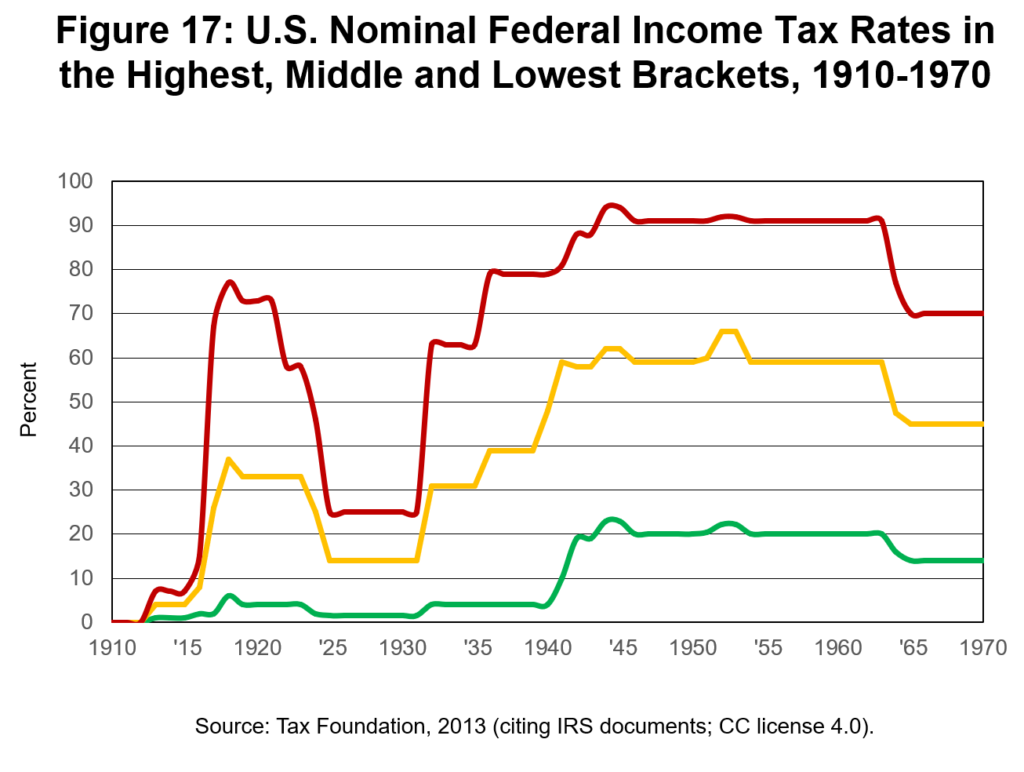
Figure 17 shows how America’s top, middle and bottom nominal/marginal federal income tax rates changed in the 1910-1970 period.62 The top rate spiked circa World War I to accelerate the payoff of related debts, came back down in the ’20s, and then, beginning with the New Deal and lasting through World War II and into the ’60s, spiked to unprecedented new heights. One can imagine those who most keenly felt the bite of Figure 17’s rising red line in in the ’30s felt that they were getting the short of end the socioeconomic power/wealth stick, and they were right in reaching that conclusion.
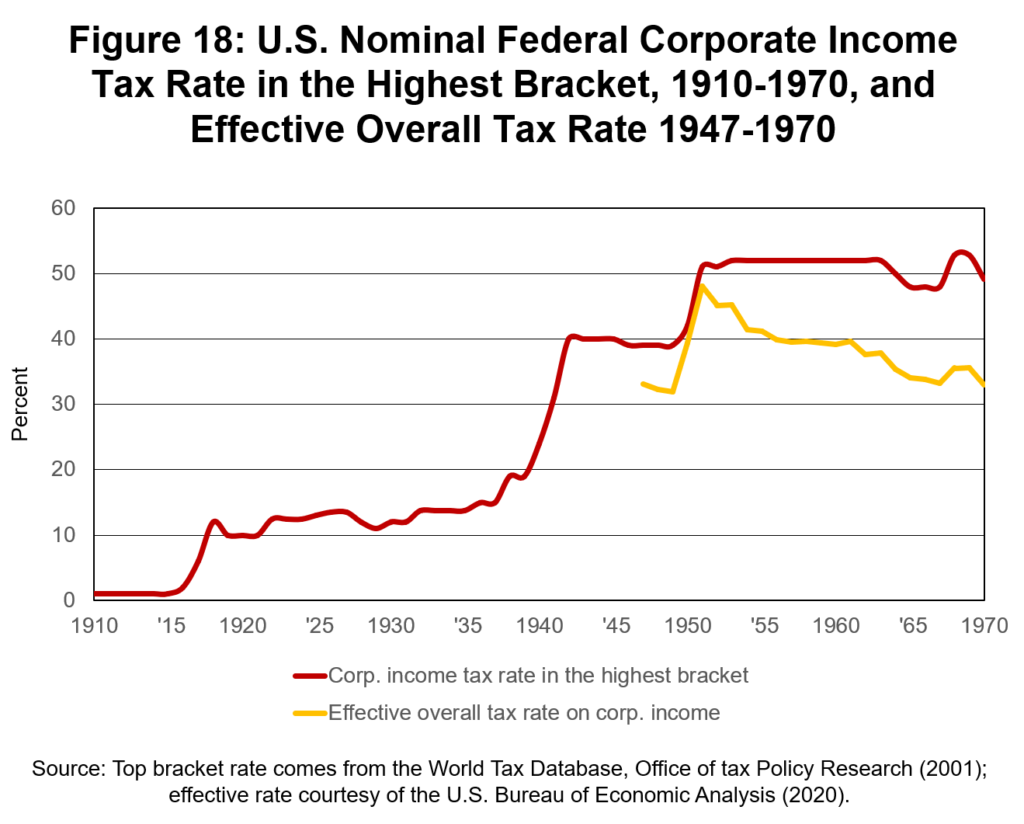
The top nominal corporate income tax rate also edged up in New Deal timeframe, and especially once World War II started. Figure 18 traces the top corporate tax bracket from 1910 to 1970. It includes the overall effective tax rate on corporate income after World War II through 1970 as well (it doesn’t appear this latter rate is readily available in the pre-World War II timeframe).63 Progressivity made its debut in the corporate tax code in ’36. That year, the top rate hit 15%, up from <14% in all previous years. The nominal top corporate rate exploded in ’39, roughly doubling to 40%. It then averaged >50% in the ’50s and ’60s. The rich got taxed more and the businesses they owned or invested in were more heavily taxed at the federal level.
The effective tax rate tells a somewhat different story. This rate drooped relative to the top nominal rate from the early ’50s through the late ’60s. We’ll get more into effective rates and the significance of this droop in in chapter 5, but it’s worth underscoring here that the top nominal rate isn’t what the typical corporation actually paid to the IRS. That droop is due to the impact of tax code progressivity (smaller corporations facing lower nominal rates) and an increase in the deductions and tax shelters that took more and more sting out of the marginal rate late in this period.
The impact of steeper and more progressive tax rates from the New Deal to 1970 dented the finances of America’s wealthiest households. The top nominal personal/household rate roughly doubled to >60% in FDR’s first term and rose again to almost 80% by the end of his second. John Galbraith calculated the share of national income going to the top 5% of individuals fell from over 30% in 1929 to around 20% by 1948, and that capital gains’ share of all personal/household income (i.e., income from dividends, interests and rents) declined from 22% in ’29 to 12% by ‘50.64 No wonder many in FDR’s class despised him!
Thomas McCraw, a Joseph Schumpeter biographer, summed up this rising anti-FDR sentiment when he wrote that, “Wealthy Americans tuned bitterly against the New Deal because of Roosevelt’s innovative economic measures.” The “rich fumed against ‘that man’ in the White House…”65 If the federal budget was to balance – the national debt had grown to $29 billion by 1935, or 39% of GDP, and both major parties agreed at this time that balancing the federal books was an important priority – then all of that countercyclical spending had to come from some tax stream. FDR and company basically tagged wealthy households and big corporations “it.”66 They paid for the New Deal, although some of that cost was deferred into a growing national debt. FDR supersized the federal budget in response to the Great Depression, but even Schumpeter admitted that in the early ’30s, the U.S. “needed one enormous infusion of public investment.”67
Figure 19 helps underscore the hit that America’s wealthiest individuals took in the New Deal years. The figure shows the share of pre-tax income per U.S. adult between 1913 and 1970, broken into four segments: top 1% earners, top 2-10% earners, the next 40% and the bottom 50%. Data are courtesy of the IRS, as gathered by the World Inequality Database, an online inequality resource that Thomas Piketty and many other economists use and contribute to in order to help complete various papers and projects.68
The income share going to the top 1% adults at the beginning of the Roaring Twenties was ~18%. Those in the 91st to 99th percentiles collected around 25%. The middle 40% received about 42% of income, leaving the bottom 50% with the other 15%. By 1950, when the New Deal and World War II were in the rear-view mirror, and when FDR’s successor, Harry Truman, was in the White House, the comparable shares had shifted to 16%, 23%, 43% and 18%. The top 1% and 2-10% segments both lost a couple percent of income in this period and the balance went to adults in the bottom 90%. These shares shifted further to 11%, 23%, 45% and 21% by ’70. The net shift from 1913 to ’70 was -8% for the top 1% and +6% for the bottom 50%. That’s called pulling down the top and lifting up the bottom.
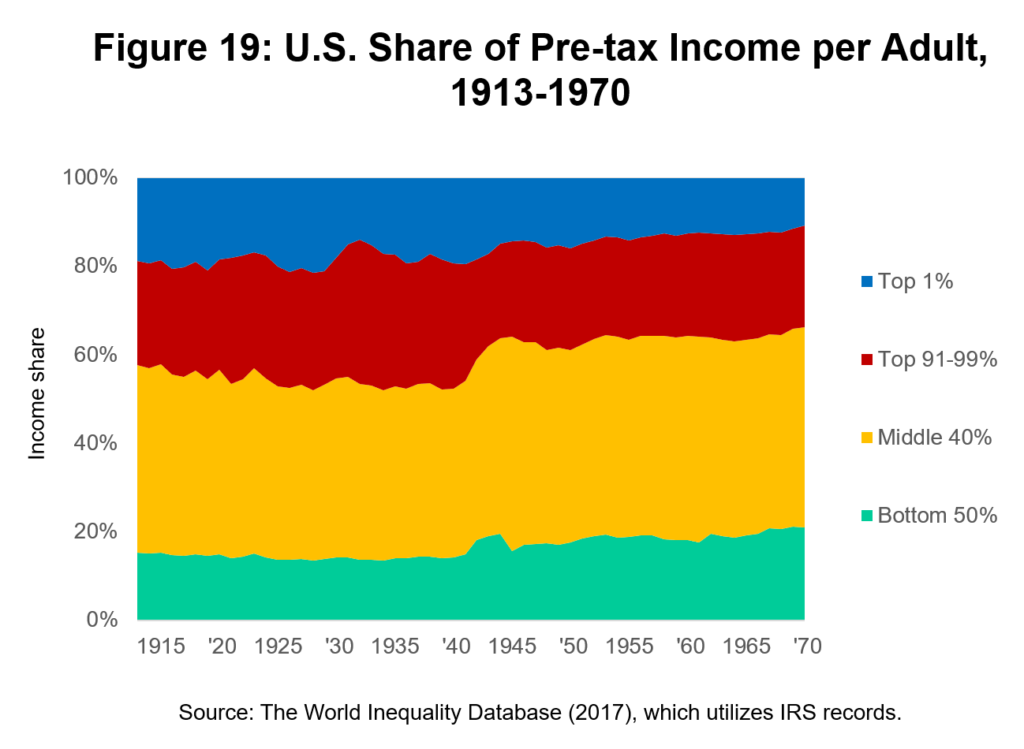
That may not sound like a huge swing, but the U.S. economy also expanded greatly in this period. It was, in fact, an enormous shift in income. Income Gini coefficients fell, particularly between the onset of World War II to 1970. We’ll revisit this topic later, but it’s worth noting here that America’s socioeconomic divisions came down in the middle third of the 20th century. FDR’s New Deal policies were a major contributor to this historic reversal. Progressive Era reforms slowed and, in some respects, halted capital’s advance in several markets in the first two decades of the 20th century, and then New Deal reforms kicked in circa ’33 and decidedly helped swung the income/wealth pendulum back in the bottom 90%’s direction through 1970. It’s about as clear of a causal chain of events as the tools of science are able to demonstrate in the real world.
One of the first lobbying outfits in Washington, DC that stood up to openly oppose FDR’s reforms was the National Association of Manufacturers (NAM). NAM had come together in Ohio in 1895. Organized labor was on the march and racking up wins by that point, and NAM was formed to blunt labor’s advance. The group’s president, at the organization’s 1903 convention, said that if unions kept advancing that “despotism, tyranny, and slavery” would result. Spoken like a latter-day Calhoun fan. One of NAM’s first acts was to call for the creation of a Department of Commerce that would counter the Department of Labor.69 In 1911, another NAM president said that the AFL was “engaged in an open warfare against Jesus Christ and his cause.” Unions weren’t only seeking a larger shore of manufactures’ profit, they were doing the devil’s bidding. NAM sought to turn antiunion sentiment into a religious crusade.
NAM’s cries didn’t fall on deaf ears. The Department of Commerce was established in 1913 but didn’t do much until Hoover took its reins in the early ’20s. He expanded its purview and it became an important sounding board for business owner’s interests at that point.70
In the ’30s, NAM went on a PR blitz extolling the benefits of unfettered capitalism and denouncing New Deal policies that were biting into manufacturers’ profits. A muckraking journalist named George Seldes maintained that NAM’s actions went further.71 In his 1943 book, Facts and Fascism, Seldes accused key NAM supporters of favoring the Italian and German fascist movements in the 1930s. Seldes produced evidence showing Lammot DuPont and Alfred P. Sloan, Jr., of the DuPont and General Motors empires, respectively, were outspoken supports of Mussolini in Italy and Hitler in Germany, and that these men subsidized fascist-leaning organizations in the U.S. while directed NAM’s anti-New Deal strategy.72
In Schumpeter view, FDRs NRA program, which had been judged unconstitutional by the Supreme Court in ’35, bore similarities to Mussolini’s effective cartelization of several large industries in Italy.73 Whether NAM or FDR was more fascist in the ’30s is perhaps debatable; what’s beyond debate is whether FDR or NAM came more down more on the side of “big labor”. On this score it was FDR in a rout, and the American public grasped this important difference, and generally approved of FDR’s bias.
NAM was ultimately shouted down. The New Deal’s tax/regulatory reforms got through congress, mostly survived their tests before the Supreme Court, and were enacted and went on to have clear social contract and socioeconomic attenuation effects. FDR’s “brain trust” was too busy to care much about what NAM was complaining about in any event. They were about to launch the New Deal’s pièce de résistance.
♦
John Maynard Keynes (1883-1946) was born in Cambridge, England to John Neville Keynes, who lectured on economics at the University of Cambridge, and Florence Ada Keynes, an early female graduate of Cambridge and an activist in local charities.74 Two younger siblings, Margaret and Geoffrey, followed by the end of the 19th century.
John Maynard showed an early aptitude for math. He won a scholarship to Eton College but later transferred to Cambridge. It was somewhere in here that Keynes had his first love affair with a man. Despite attending religiously affiliated schools as a child, he also appears to have embraced atheism at or before getting to Cambridge.75
Upon graduation, he took a civil service job but soured on it quickly. Maynard, as his friends and family called him, sulked back to Cambridge in 1909 and found employment as math tutor and as an occasional lecturer at his alma mater (a personal endowment from the aged lion of British economics, Alfred Marshall, helped in this regard). World War I put Keynes on a new course as it did so many other lives. His stint as a civil servant and some of his first professional writings on economics caught the eye of someone at the Treasury. He was offered a job there in 1915. Maynard received an exemption from military conscription in 1916, with the provision that he kept his Treasury job.76
In the wake of the Allies’ victory, Keynes joined a Treasury delegation that headed to Paris and Versailles to help hammer out the peace accords. The Allied Powers dropped the hammer on Germany in France; the German delegation walked out on their tough “take it or leave it” offer. Keynes believed the reparation terms imposed on Germany were excessive and counterproductive to European prosperity but he was powerless to influence the final arrangement.77
Keynes resigned from the delegation and, late that year, wrote a book based on his experiences in France. The Economic Consequences of the Peace gave him his first taste of fame. In the book, Keynes argued it wasn’t in the economic interests of Europe as a whole to slam Germany as the Treaty of Versailles had, and he warned that negative consequences could flow from it:78
The policy of reducing Germany to servitude for a generation, of degrading the lives of millions of human beings, and of depriving a whole nation of happiness should be abhorrent and detestable, – abhorrent and detestable, even if it were possible, even if it enriched ourselves, even if it did not sow the decay of the whole civilized life of Europe. Some preach it in the name of Justice. In the great events of man’s history, in the unwinding of the complex fates of nations Justice is not so simple. And if it were, nations are not authorized, by religion or by natural morals, to visit on the children of their enemies the misdoings of parents of rulers.
Keynes also noted in the book that Herbert Hoover, who was part of the American delegation, was of a similar mind.79 (In 1919, Hitler was a domestic spy who was sent by the army to infiltrate a new political group called the German Workers’ Party; a year later, Hitler had been discharged from the army, had designed the swastika, and had taken a full time job at the renamed National Socialist German Workers Party – the vehicle that put him in the path to becoming the chancellor of Germany.80)
In the early ’20s, Keynes met and fell for an ex-pat Russian ballerina, Lydia Lopokova. It surprised many of his old friends to learn that Maynard was bisexual. An ex-lover, Duncan Grant, was best man at the wedding. It must have been quite a reception! Lydia got pregnant in ’27 but miscarried, sadly, and the pair ultimately had no children.81
Keynes’ professional interests, meanwhile, shifted toward how unemployment, money and finance, and market prices interacted. The title of a 1926 essay, “The end of laissez-faire” gives an inkling of this new direction. While Keynes supported capitalism, he was concerned that the economic system also required more oversight than it generally got, writing, “For my part I think that capitalism, wisely managed, can probably be made more efficient for attaining economic ends than any alternative system yet in sight, but that in itself it is in many ways extremely objectionable.”82 Coolidge was president across the pond, and his administration’s foremost policy in the Roaring Twenties was hitting the snooze button.83
A Treatise on Money was published in 1930. This two-volume work distinguished savings from investment capital and suggested recessions were primarily the result of too much saving and not enough investment. The book also posited that national income was a more accurate gauge of prosperity than how much gold, silver or other physical assets a nation possessed, and underscored that consumption – demand for goods and services – was the most important driver of national income.84
The Great Depression didn’t just hit America like a ton of bricks. It fell on England and many other countries as well. Alternatively known as the Great Slump, it was the UK’s worst downturn of the 20th century to that point. Britain’s foreign trade dropped by half, heavy industrial output fell by a third, and the ranks of the unemployed swelled to 3.5 million in the 1932-1933 timeframe.85 Near the bottom of the slump, wrote Keynes, “The decadent international but individualistic capitalism in the hands of which we found ourselves after the war is not a success. It is not intelligent. It is not beautiful. It is not just. It is not virtuous. And it doesn’t deliver the goods. In short we dislike it, and we are beginning to despise it. But when we wonder what to put in its place, we are extremely perplexed.”86
The slump did provide Keynes an opportunity to see if his new theories about how different types of money, government policies and private sector decision-making related. The consensus view among economists prior to the Great Depression was that prices and wages fell rapidly in a recession, reached a new equilibrium, the market cleared at this “new normal”, and then economic activity began building from there and the recession ended.87 Three years into the Great Slump it was clear this process hadn’t played out along theoretical lines.
Keynes believed the reason that reality had diverged from consensus theory had to do with the psychological makeup of the people involved. Like corporations, people typically tried to hold onto as much of their cash and assets as possible when a downturn hit. They exhibited the opposite behavior in boom years. An invested dollar or pound in an expanding economy is generally worth more tomorrow than a saved dollar or pound. Not to invest in a growing economy is like leaving free money on the table.
This insight is one of the cornerstones of the Keynesian macroeconomic model upon which every market-based economy still relies.88 This savings-investment dynamic has since been renamed a liquidity preference. When investments exceed savings in an economy, inflation and economic growth generally follow (although runaway inflation is a bad thing), and when savings overtakes investment, deflationary pressures typically gain the upper hand, and a downturn generally follows. It’s a modest step from there to suggest that if governments step up social investments in a way that drives demand among market agents broadly, that unemployment would get downward pressure as businesses hire to fulfill that demand increase, and a recession can end faster.89
The Keynesian prescription for getting out of the Great Depression—tax cuts paired with more government spending (and the opposite policy once the economy recovered and was growing steadily)—challenged the prevailing prescription that most economists advanced and blew a hole in the side of the laissez-faire philosophy at the same time. A vision of a potential yin-yang, complimentary relationship between active governments and market-driven enterprise activities emerged from of the mist.
Keynes built out this thesis further in 1933’s The Means to Prosperity. He there suggested that governments could shorten the Great Depression, and help citizens and businesses, by engaging in more counter-cyclical public spending, and underscored that would be most effective if that spending targeted people in the bottom half of the social strata because their increased ability to buy goods and services would induce businesses to crank up the supply wheel. The book spelled out in plainer language that governments should be greasing the wheels of commerce even if it threw their budgets out of balance. Governments in market-based economies were not “just another big business.”
A copy of The Means to Prosperity landed on FDR’s desk. It wasn’t a tough sell. FDR had been practicing Keynesianism for years without knowing it had a name and certainly without a deep theoretical model behind it.90 FDR’s pragmatic win-win-win approach is what macroeconomists have since dubbed a multiplier effect. Even Schumpeter bowed before Keynes on the importance of this innovative insight.91
If multiplier effects are real then so is the Arrow-Smith ideal (and the anarcho-libertarian ideology is nonsense). If smart dollars or pounds invested by a governing body in a recession indeed returns more than a dollar or pound in value to that society, then the governing body and that society are stupid if they don’t make that investment. It’s like leaving “free money” on the table. Smart countercyclical government spending is the yin to the corporate and personal profit-seeking (shrewd investment) yang in boom years. Good governance is about saving the system money and resources over the long term. That’s a good idea. Each dollar or pound that’s saved by a shrewd government today is a dollar or pound that doesn’t need to be spent by private sector market agents tomorrow, and at a higher cost, and vice versa. It’s about systemic efficiency.
The Arrow-Smith’s ideal’s public good system, and the governance component of the wikicapitalist economic model that’s promoted in Book II, can be thought of as an aggregation of multiplier effects. In good times, government tax rates should go up relative to the rates that apply in a downturn in order to ensure the governing body’s books stay balanced over the long-term, and government spending should fall in boom times. A corollary of the second tenet of the Arrow-Smith ideal that relates to market containers is that economies should keep their governing body’s books balanced in the long run (it’s the internal equivalent of the “no sustained trade deficit” tenet).
Adam Smith called public debts “pernicious” and said that the attempts he witnessed to downplay their importance were “founded altogether in the sophistry of the mercantile system, and after the long examination which I have already bestowed upon that system, it may perhaps be unnecessary to say anything further about it.”92 When public debts are held by foreign nations, the associated interest payments flow out the country. Sustained government deficits reduce the long-term wealth of nations as a result. Deficits do matter.
Keynes and FDR met in 1934. Keynes struck FDR as someone who was overly focused on numbers and FDR came across to Keynes as neophyte on economics. After the meeting, Keynes struck a diplomatic note:93
The economic experiments of President Roosevelt may prove, I think, to be of extraordinary importance in economic history, because for the first time—at least I cannot recall a comparable case—theoretical advice is being taken by one of the rulers of the world as the basis of large-scale action. The possibility of such a remarkable event has arisen out of the utter and complete discredit of every variety of orthodox advice. The state of mind in America which lies behind this willingness to try unorthodox experiments arises out of an economic situation desperate beyond precedent.
Keynes’ theories were being put into real world practice in America. Keynes had won over the government of a major global superpower, despite the objections raised by several of FDR’s economic advisors. Keynes kept analyzing the economic data that poured in from the U.S. and the UK, and further refined his models until 1936. Only then, when he felt confident his theories would withstand more real-world testing, did he spike the proverbial football and publish of his magnum opus, The General Theory of Employment, Interest and Money.
The meeting between Keynes and FDR has been finagled by Louis Brandeis. Brandies was part of FDR’s “brain trust”, as was Adolf Berle, who’d previously met Keynes.94 Berle, a lawyer, author, diplomat and, at age 21, the second youngest graduate of Harvard Law, had put in a stint at Brandies’ Bostonian law firm after graduation. Berle inherited the full #progpop genome and, in time, became Brandies’ and FDR’s main go-between.95 Berle got acquainted with Keynes in the hubbub surrounding the Treaty of Versailles. Brandies had read Keynes’ work by ’32 and had introduced Keynesian ideas into “brain trust” discussions.96 Hence the ’34 meeting when Keynes came to the U.S. to promote The Means to Prosperity.
The timing of the meeting was fortuitous in that Social Security was taking shape at that point. Dozens of books have been written about Social Security and I don’t pretend to be expert on this massive topic. Suffice to say that Social Security rewired America’s social contract. My only point is rather superficial: that Social Security is remarkably Keynesian in both its design and net long-term impact.
FDR signed the Act into law in late ’35. The unemployment compensation part of it (Title III) was largely derived from a Wisconsin law enacted in ’32. Brandies loved the approach.97 The program was voluntary to employers but nonparticipating companies got taxed. The idea was to create a disincentive for employers to lay off workers in a downturn by making those companies responsible for paying part of employees’ wages for a specified period after they’d been let go, assuming workers weren’t fired for cause. That was a novel concept. The law defines a worker, defines involuntary termination, and spells out the benefits that ex-workers are owed based on a new tax that applies to employer payrolls.98
Using this state-level approach as a template (other states, including New York, were also in various stages of adapting the Wisconsin model), FDR’s administration erected federal-state partnership superstructure. The new federal payroll tax was introduced. In order to get every state/district/territory on board, employers in locales that had a qualified unemployment insurance law could get credits that offset 90% of the new federal payroll tax.99 Other elements of the Social Security Act provide direct financial assistance to the elderly (Title I; elderly poverty rates topped 50% in the Great Depression prior to Social Security’s passage) and define other payments going to single mothers, widows, blind people and other vulnerable social groups.100
Drafting of the legislation was largely left in the hands of FDR’s capable Labor Secretary, Frances Perkins. Born in Boston, Perkins studied chemistry and physics at Mount Holyoke College, where she became class president.101 After witnessing the Triangle Shirtwaist Factory fire in 1911, which killed 123 women and girls and 23 men in New York City’s Greenwich Village, Perkins veered in the direction of workers-rights and sociology.102 She and FDR eventually moved into overlapping social orbits, met, and hit it off. When it came time to tap the fourth Secretary of Labor, one name in particular came to mind. Perkins became the first female cabinet member in U.S. history, which probably felt damn sweet to a latter-day suffragette. #progpop. Perkins was part of FDR’s brain trust, was well-acquainted with Keynes’ work prior to the ‘34 tête-à-tête between FDR and Keynes, and was on hand on the day the two men met.103
Social Security became a big piece of the federal tax pie in short order. As figure 20 shows, Social Security spiked to 27% of federal revenue by 1940, shrunk to single digits in the mid-40’s, and then crept back up to 23% by 1970. Other big tax slices in this period were personal/household and corporate income taxes, and excise taxes (that latter are producer-paid taxes on fuel, tobacco, alcohol, air travel and more).
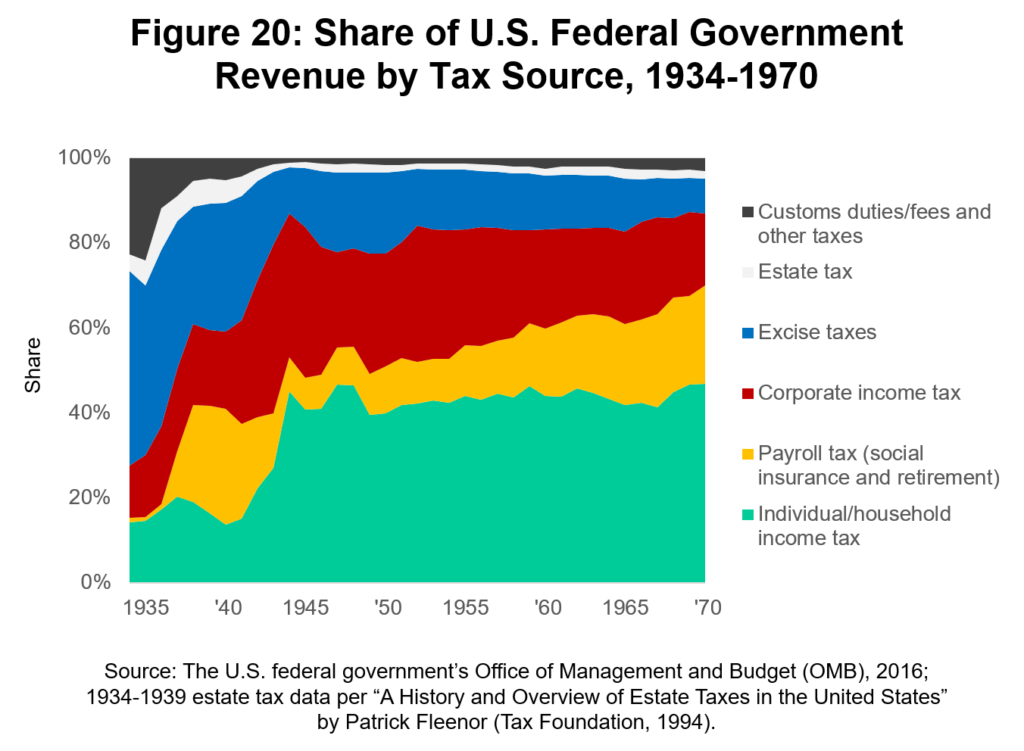
The yellow slice in the middle of Figure 20 may be interpreted as Keynes’ chief legacy as it relates to the daily operations of the U.S. economy. Social Security reduced socioeconomic inequality while enhancing national stability, then as now, by uplifting people at or near the bottom of society, and by seeding bottom-up demand for goods and services that helps suppliers. Social Security created a shock absorber at the base of the social structure. Subsequent generations of Americans haven’t suffered the metal-on-metal grind that the nation’s poorest people most vulnerable groups endured in the Great Depression. You’re welcome.
If there were lingering doubts as to whether Americans felt that FDR was on the right track, they were dispelled in late ’36. Alf Landon, FDR’s opponent in the presidential race that year, was governor of Kanas. Landon had become a millionaire in the ’20s based on his ownership of a petroleum extraction business (and he’s moonlighted as a lobbyist for oil/gas interests in the state as well).104 Landon went after FDR on the campaign trail for being too tough on business and vaguely accused him of corruption.
FDR’s response was to lampoon the “economic royalists” who opposed him and his policies. Landon fit the bill to a T. FDR told a hyped-up Madison Square Garden audience on the eve of the election that that the rich “are unanimous in their hate for me, and I welcome their hatred.”105 FDR got 61% of the vote, four points better than his ’32 margin. It was the biggest presidential landslide since 1820. Landon carried two states.106 The nation wasn’t in much of a celebratory mood after the win. FDR and his brain trust rolled up their sleeves and got back to work.
♦
Fresh off signing the Robinson-Patman Act that barred producers from price discrimination (in effect, big producers could no longer give exclusive economies of scale-based discounts to their biggest customers), FDR and company got into the weeds of labor law and began to craft what become 1938’s Fair Labor Standards Act (FLSA).107 The FLSA established, for companies above a certain revenue threshold, a national minimum wage and mandated “time-and-a-half” pay for workers that went over a forty-hour workweek. The Act prohibited certain types of child labor too.108
The U.S. economy began to show signs of recovery as early as 1933. The leading economists who hadn’t smitten by Keynesianism by ’34 – which was most of the profession, and the “orthodoxy” to which Keynes referred coming out of his meeting with FDR – kept jawboning the president to cut federal spending. Their prescription, which was basically rehashed Hooverism, was that the government needed to cut spending because it was effectively a variant on a big business and this business was losing money hand over fist. These advisors wanted the federal government to get out of the red, and implored FDR to balance the budget. GDP had grown at a double-digit rate from 1933-1936, they pointed out, and unemployment had fallen from 25% to 14%.109
Other economic indicators weren’t as positive, but FDR relented. His administration pulled back on federal spending (the WPA’s budget was particularly slashed), taxes were raised (see Figure 17), and the Fed tightened up on the money supply.110 The pre-Keynesian economists and advisors all hailed these changes.
Their jubilation proved short-lived. The economy took a turn for the worse in mid-1937. FDR got the federal budget to balance that year, but the country also fell into sharp recession that didn’t relent until late 1938.111 Unemployment ticked back up towards 20% and GDP went negative. Perhaps if FDR had read the preface to The General Theory of Employment, Interest and Money with more care, this painful episode might have been averted. Wrote Keynes, “The difficulty lies, not in the new ideas, but in escaping from the old ones, which ramify, for those brought up as most of us have been, into every corner of our minds.”112
FDR was a quick study. He wheeled himself back onto the Keynesian bandwagon in early ’38, asking Congress to approve a $5 billion stimulus package designed to make “additions to the purchasing power of the nation”. Deficit spending was back on the menu, and in a national radio address that aired before Easter, the revitalized Keynesian played a New Deal greatest hits medley, then laid out what was needed next:113
This recession has not returned to us [to] the disasters and suffering of the beginning of 1933. Your money in the bank is safe; farmers are no longer in deep distress and have greater purchasing power; dangers of security speculation have been minimized; national income is almost 50% higher than it was in 1932; and government has an established and accepted responsibility for relief.
But I know that many of you have lost your jobs or have seen your friends or members of your families lose their jobs, and I do not propose that the Government shall pretend not to see these things. I know that the effect of our present difficulties has been uneven; that they have affected some groups and some localities seriously but that they have been scarcely felt in others. But I conceive the first duty of government is to protect the economic welfare of all the people in all sections and in all groups. I said in my Message opening the last session of the Congress that if private enterprise did not provide jobs this spring, government would take up the slack – that I would not let the people down. We have all learned the lesson that government cannot afford to wait until it has lost the power to act.
Unemployment began to fall and GDP turned positive within three months of Congress cranking up the countercyclical spending amp again.114 The episode was as clear of a vindication of Keynes’ theories as one could expect from the real world (although FDR rarely acknowledged Keynes’ influence in public).
Practically all capitalist economies followed America’s experiment with Keynesianism with interest in the mid- to late-1930s and began weighing the merits of similar macroeconomic policy changes. By the 1960s, Keynesianism was the norm rather than the exception to the rule in most such countries. Keynes went from insurgent heretic to canonized saint in about a generation, and his message was honed and promulgated by a generation of economists that followed, including John Galbraith, Paul Samuelson, Franco Modigliani, James Tobin, Robert Solow, Michał Kalecki, Nicholas Kaldor, Sidney Weintraub, Paul Davidson, Piero Sraffa, Jan Kregel, among others.115
A key point of The General Theory of Employment, Interest and Money is that economies typically grow as long as aggregate demand stays elevated. The focus on macroeconomic indicators such GDP, the sum value of goods and services sold in a given period of time, is vital in tracking economic health as a result. More governments began collecting much more economic data, and assessing it with far more care coming out of the Great Depression. The seeds of the IRS’s SOI group were planted at that time.
Keynes went out on another limb and posited that companies produce only the output that they expect to sell. Whatever stimulated demand stimulated business activity and prompted hiring.116 Presidential press releases won’t cut it. Businesses that receive stimulus money in a downturn (deficit spending resources from government), it follows, will often pocket this money (save it rather than invest it) or perhaps send it back out to shareholders in the form of dividends if they’re a public company (and those recipients often put it in a savings account in a downturn). The result is a negative multiplier effect.117 Giving corporations money directly in a downturn is a bad policy. You’re better off giving that money to people of moderate to modest means because they’re far more likely to spend it on the necessities of life, Keynes implied.
Keynesianism was the crucible in which G.E. theory came together and it helps explain why the second theorem is there: New Deal policies in the Great Depression showed that active governments could deliver big socioeconomic upsides, and Ken Arrow and Gerard Debreu were simply acknowledging this fact in their model of idealized market-based economies. Democratic governments were part of the solution in well-run market economies, not some problem to be minimized, not “the enemy” of corporations. An important implication of the second theorem of General Equilibrium is that it’s not a zero-sum game between companies, citizens and governments. Keynesianism maintains that when the social contract relationships are kept in wise balance it’s more like a 1+1+1=4 relationship.
The historian Arthur Schlesinger wrote that after ’35 the New Deal was effectively “a coalition of lawyers in the school of Brandeis and economists in the school of Keynes.”118 FDR and company surely doubled down on next-gen #progpop policy prescriptions in the wake of the ’37 recession. These policies, in turn, pushed America in the direction of the Arrow-Smith ideal.
Louis Brandies began to lose steam in the late 1930s. He retired from the Supreme Court in February of ’39 and died of a heart attack in October 1941 at 84, two months before America entered World War II. He may have been slight of build, but the shadow he cast over Progressivism was massive. Brandies understood political democracy as deeply as anyone and wrestled as mightily as anyone in the early 20th century with how to realize the economic equivalent of democracy in a country in which massive corporations dominated most industries.
Per biographer Philippa Strum, where Brandies ultimately landed was that Progressivism’s goal “…and that of the New Deal, was to divide the economic pie into a far greater number of slices even if that meant reducing the size of some of the larger pieces. The emphasis was on raising the workers’ standard of living; the assumption was that having done that, maintaining a regulatory system would preclude a return to the earlier level of inequality and exploitation.”119 In the pre-World War II era, Brandies and Keynes have to be considered the most effective proponents of what I’ve here called the Arrow-Smith ideal and wikicapitalism.
Brandies sought not only more robust profit-sharing plans between workers and employers but more active worker participation in business management. It wasn’t a “you give me more money, thanks” tweaking of the employee-employer relationship so much as “you give me more money and I’ll give you back something else of equal or greater value” exchange. To Strum’s way of thinking, the reality of the New Deal fell well short of Brandies’ ultimate vision:120
Whether even such a charismatic leader as Franklin Roosevelt could have convinced the American public that individual liberty necessitated scaling down the size of business and beginning the introduction of worker-management and whether, if he had done so, the political influence of the giant corporations would have prevented Congress from enacting the necessary legislation are yet other unanswerable questions. But no such attempt was made, and the possible solution to the problem of protecting economic liberty and independence in an industrial society received neither full-scale discussion nor meaningful experimentation during the period that may have been the one “window of opportunity” for that attempt in American history.
Brandies was concerned to the end that if America didn’t address its inequality problems structurally (by establishing a “regulatory system” that permanently precluded a high “level of inequality and exploitation” of frontline employees) that the door to fascism would remain open.121 Highly unequal capitalism, European fascism and Russian Communism shared important common characteristics in Brandeis’ mind. They all delivered the opposite of the chocolate-peanut butter marriage that he (and Keynes) sought.
Brandies’ wanted Social Security to be a state-federal partnership precisely because he believed distributed socioeconomic power was always a better way to go than a more centralized power/money approach. He was concerned that if this new, mammoth program were managed nationally that the door to its corruption and abuse would also be more open.122 Additional sunshine and more deeply distributed socioeconomic power was always better for democracies and market-based economies to Brandeis’ way of thinking.
Germany has invaded Poland by late 1939. That America might get sucked yet into another devastating European conflict loomed large as the 1940 presidential race entered the home stretch. Hitler was in charge in Germany and was threatening to invade Britain. Unemployment in the U.S. had fallen to ~14% by the time of the election. Wendell Willkie, another Republican businessman from New York, fell under FDR’s steamroller this round. Willkie got <45% of the popular vote and carried ten states; FDR’s electoral college margin increased over 1936.123
FDR pushed the Lend-Lease Act through Congress early in his third term. That legislation squarely placed America in the Allied camp once again and kick-started a mammoth arsenal production process. Practically anyone who wanted work soon had it. The Great Depression moved into the rear-view mirror at long last. More deficit spending and an extremely proactive government had put the final nail in its coffin.
The Great Depression and World War II were arguably the two greatest existential threats to America’s survival in the 20th century. They came back to back and were incredibly costly and transformative in different ways. Only one was a self-inflicted wound. The Great Depression was understood by most Americans, economists and politicians to be a domestic market failure, a failure brought about by inadequate and ineffective oversight of business activities by government, and by irresponsible if not clearly anticompetitive practices employed by some of the nation’s biggest businesses, banks and investment firms. The basis for this conclusion is woven through the lives of Brandies and Keynes. Their epitaph in America, though, may be best expressed in a document that’s been all but lost to the sands of time.
References
