So it is not an accident that the Nazi lads vent a particular fury against him [Albert Einstein]. He does truly stand for what they most dislike…How should they know the glory of the free-ranging intellect and soft objective sympathy to whom money and violence, drink and blood and pomp, mean absolutely nothing?
– John Maynard Keynes
The price of the Allied victory in World War II was extreme, and the defeated Axis powers paid more dearly still. Over a hundred million soldiers and direct support personnel in scores of countries were eventually sucked into the conflict that raged from September 1939 to August 1945. Blood spilled on every continent save Antarctica. Military and civilian deaths easily topped 70 million and probably topped 80 million.1
World War II shook the globe to a greater degree than World War I. The realignment of political and economic maps after the war was even more profound. President Wilson’s dream of an international body that advanced diplomacy and peace after World War I came to fruition after World War II in the United Nations.2 If they existed, World War II’s big winners – China, France, the Soviet Union, the UK and the U.S. – became the UN Security Council’s five permanent members, an arrangement that’s still in place.
America was again spared the physical, psychological and spiritual devastation that much of Europe and Russia endured during and shortly after the war’s conclusion. The U.S. economy consequently rebounded more quickly. Europe’s ruin and its loss of power fomented the decolonization of Africa and Asia. The Soviet Union was half wrecked and China fell into a Civil War as World War II ended. The Soviet Union and China emerged as American rivals in the decades after the war’s end because they obtained nuclear weapons and opposed capitalism and democracy, but it wasn’t a close contest economically (i.e., as measured by GDP) for the rest of the 20th century.
John Maynard Keynes was in a very different position after World War II than when he’d gone to France on behalf of the British Treasury at the conclusion of World War I. Keynes was determined to see the Allied leaders not make the mistakes of their predecessors at the Treaty of Versailles. The main results along these lines, with plenty of other potent cooks in the kitchen to be sure, was the Marshall Plan and Bretton Woods Agreement. These two policies helped redesign the geopolitical and socioeconomic maps that still affect international relations today.
The Marshall Plan was named after the U.S. Secretary of State at the time, George Marshall. A former Army general, Marshall worked his way up through the ranks during FDR’s long tenure as president, and Marshall developed parts of the plan and orchestrated its implementation.3 In mid-1947, he gave a speech at Harvard that described how America intended to bankroll Europe’s reconstruction and offered a vision of the new peace. The U.S. was the only nation on Earth with a nuclear weapon at that point so pretty much everyone grabbed a chair and took notes. The Marshall Plan’s blueprint was a close variant of what was laid out in the pages of The Economic Consequences of the Peace.4 Said Marshall at Harvard:5
It is logical that the United States should do whatever it is able to do to assist in the return of normal economic health to the world, without which there can be no political stability and no assured peace. Our policy is not directed against any country, but against hunger, poverty, desperation and chaos. Any government that is willing to assist in recovery will find full co-operation on the part of the United States. Its purpose should be the revival of a working economy in the world so as to permit the emergence of political and social conditions in which free institutions can exist.
This would be a generous peace for the losers, unlike the Treaty of Versailles. The measure passed Congress in early 1948 (with 17 senators dissenting, mostly Republicans).6 America loaned or gave over a dozen European states and Turkey about $12.4 billion over the next four years, the equivalent of ~$128 billion today, to help them rebuild more quickly. The three biggest recipients ultimately were the UK (26%), France (18%) and Germany (11%).7 There’s a reason West Germany joined NATO in 1955. Those wheels started moving in lockstep with Marshall Plan funds and assistance. Keynes wasn’t involved in its implementation, but the design and net effect of the plan was deeply Keynesian.
The plan worked. Not only hasn’t Western Europe descended into an internecine war since World War II, but its various economies have all grown tremendously and become so intertwined (due to trade/travel/economic barrier reductions and agreements) that such a conflict is all but unimaginable today. International trade surged after the war. Global trade rose by >7% a year, if fact, from 1948 to the early ’70s.8 Rising transatlantic and intra-European trade was a massive factor in this outcome. The Marshall Plan delivered a global multiplier effect that redounded to America’s and the world’s longer-term benefit.
Europe procured endless boatloads of American goods with Marshall Plan funding. Food and fuel were paramount early on, but after a couple years, the emphasis shifted to raw building materials, finished machines, vehicles, equipment, etc.9 America’s foreign trade balance was positive in the early 1950’s and more often than not was positive to the tune of >$100 million per month.10 We had the largest economy on the planet and were a net exporter – our economic engine got an external tailwind.
The Bretton Woods Agreement bore Keynes’ imprimatur more directly. It was the first negotiated monetary order governing the monetary relations of many countries. If you’ve heard of the IMF, now you know where it began.11 The agreement came together faster than the Marshall Plan. Over 700 delegates from 40+ Allied nations convened in Bretton Woods, New Hampshire in mid-1944 to discuss a post-war financial system. Keynes and the U.S. Treasury’s chief international economist, Harry Dexter White, were front and center and butted heads on several key details. Keynes’ plan, drafted for the British Treasury, differed from White’s approach in that Keynes emphasized economic growth and White focused on price stability.12 White mostly got his way. The U.S. dollar became the reserve currency underpinning the agreement’s currency exchange rate system.
Enough delegates went home and got the agreement passed locally that pieces of it, including the IMF, went operational shortly after the war ended. IMF loans began to flow in ’47, about a year before the Marshall Plan’s spigot got turned on. The Soviet Union declined to participate in the Marshall Plan and Bretton Woods Agreement.13 The seeds of the Cold War had clearly sprouted by ’47. Bretton Woods fell apart in the early ’70s, but the number of participating countries that endured a serious banking crisis while the agreement stood was zero. It’s a far cry from the status quo that preceded the agreement and that’s followed in its wake.14
The Marshall Plan and Bretton Woods Agreement were Keynes’ swan songs. They were high notes to go out on, and much of the world is still humming a Keynesian tune whether it knows it or not. A series of heart attacks undid Maynard in ’46. He died at his farmhouse in East Sussex, aged 62.15 His ashes were scattered on local downs. His widow, Lydia, lived a quiet life in that home until shortly before her 1981 death.
How can one sum up Keynes’ life and legacy? For starters, like Brandeis, he wrestled with how to optimally balance economic efficiency, social justice and individual liberty in a market economy.16 Anyone that’s traveled to this intersection since owes Maynard a debt of gratitude because he built and turned on a streetlamp there. He was a true believer in the power of the “dismal science.” Three lines from The General Theory of Employment, Interest and Money should suffice. “The ideas of economists and political philosophers, both when they are right and when they are wrong are more powerful than is commonly understood. Indeed, the world is ruled by little else. Practical men who believe themselves to be quite exempt from any intellectual influences, are usually slaves of some defunct economist.”17
Keynes put his faith in the scientific process. In more than one instance he was accused of changing his mind. His retort was invariably something like, “When my information changes, I alter my conclusions. What do you do, sir?” He was a shrewd investor and a popular writer. He’d amassed a modest £500,000 fortune, or nearly $20 million today, by the time of his death.
In the end, like Brandies, Keynes was a rather classic liberal. Both these men embraced innovation and had no qualms about decimating an orthodox, conservative order that stood between them and the serene light of reason and moral rectitude that was based in the Enlightenment’s ideals. “They offer me neither food nor drink—intellectual nor spiritual consolation…It [Conservatism] leads nowhere; it satisfies no ideal; it conforms to no intellectual standard, it is not safe, or calculated to preserve from the spoilers that degree of civilisation which we have already attained.”18 Keynes kept a weather eye on conservatives because he knew their schemes to undo competitive capitalism and sow inequality in democratic societies in order to further empower would-be and de facto oligarchs and monopolists were legion.
As long as we’re pouring one out for Maynard, let’s pour one out for FDR. More ink has been spilled on FDR than Keynes, so I won’t belabor Roosevelt’s legacy. Suffice to say that the New Deal rewired large chunks of the American social contract and bent the nation towards the Arrow-Smith ideal. FDR alleviated or prevented a great amount of pain and suffering in his life. What better legacy could one leave?
FDR established the Fair Employment Practice Committee (FEPC) in the last years of his life. The effort led to the federal government and its contractors banning discriminatory hiring practices based on race, color, creed or national origin.19 He also signed Executive Order 8802 during World War II. That order was an attempt to excise racial discrimination in the defense contracting sector.20 These actions foreshadowed the civil rights movement and the federal government’s response to it in the 1960s. FDR wanted the lives of America’s racial and ethnic minorities to get better – assuming that we’re willing to overlook the internment of >100,000 Japanese-Americans from 1942 to 1944.21 FDR accelerated Jewish immigration from Europe in ’44 and helped set the stage for the establishment of the Jewish state in Palestine after the war as well.22
Another New York Republican fell victim to FDR along the way. FDR won a slimmer 53% of the popular vote in the ’44 election cycle, but his opponent, Thomas Dewey, ultimately carried just 12 states.23 It was an electoral college drubbing. Within three months of being sworn in as president for an unprecedented fourth term, FDR had died of a massive stroke, aged 63. Vice-president Harry Truman, a former senator from Missouri, was sworn in as commander-in-chief on April 12, 1945, four months before the end of World War II. FDR was buried in the garden of his Springwood estate in Hyde Park, New York, which became a National Historic Site shortly thereafter.
FDR indirectly lifted John Galbraith’s fortunes on his way out the door. The federal government set up a rationing system during World War II. The agency tasked with the effort was the Office of Price Administration (OPA). Its goal was to check inflation that resulted from high demand for, but limited supply of key war-related materials and services. Galbraith later said that his stint at the OPA was his life’s greatest achievement because the agency managed to keep prices and rents fairly stable at a critical time when instability was the norm.24 Galbraith was forced from the OPA in ’43 after being accused of harboring “communistic tendencies” by conservatives.
Galbraith was awarded a World War II Medal of Freedom in ’46 for his wartime efforts. He went on to pen The Great Crash, 1929 and other influential works in the ’50s, and served as President Kennedy’s ambassador to India. He settled in at Harvard after that, teaching economics in the post-Keynesian vein – and railing against latter-day laissez-faire governance fans in the process – until he retired in the mid-1970s.25
♦
1948 was another election year and Truman reminded voters on the campaign trail what had caused the ’29 stock market crash and Great Depression. “Selfish men have always tried to skim the cream from our natural resources to satisfy their own greed,” he told a Salt Lake City audience. “And they have always sought to control the Government in order to accomplish this. Their instrument in this effort has always been the Republican Party. The Republican administrations of our time have done their best to make the West an economic colony of Wall Street. In the 1920’s, under Harding, Coolidge, and Hoover, quick and greedy exploitation was the order of the day.” FDR flashed a winning grin from on high that day.
Truman eked out a W with slightly under 50% of the vote. The Republicans had run Dewey again and he received 45% of the vote. A short-lived pro-segregation party, the Dixiecrats, collected most of the remainder and carried four Southern states (Truman carried 28 states to Dewey’s 16).26 The Dixiecrats had come together in ’48, after Truman signed Executive Order 9981, which began the desegregation of the Armed Services. 90% of African-American troops were integrated into the Army by the end of ’53. The Dixiecrat rebellion showed that Democrats’ once rock-solid support in the former Confederate South was crumbling as pro-segregation white voters abandoned the party.27
The Truman administration beefed up antitrust regulations in 1950. The Celler-Kefauver Act amended Clayton, closing a loophole on asset acquisitions and asset purchases by firms that weren’t in direct competition.28 Businesses had again started violating the spirit of Sherman by buying up competitors’ assets but not purchasing the associated stock, which Sherman barred. Alternatively known as the Anti-Merger Act, these new laws gave the federal government additional power to deny vertical mergers as well as horizonal/conglomerate mergers which it determined to be detrimental to competitive dynamics. It’s hard to overestimate the esteem in which the U.S. government was held at that point. Its decisions got the benefit of the doubt domestically and internationally.
The top nominal tax rate on personal/household income stayed above 90% through the Truman administration. The top nominal corporate income tax rate also exceeded 50% in the early ’50s. These policies enjoyed bipartisan support because America had incurred huge was debts and both major parties, as they had in the past, agreed that paying it off these debts was an important national priority. America’s total debt load in 1941 was $49 billion, or 38% of GDP. By ’45 it was $259 billion, 114% of GDP.
Wars have always been an excellent way to supersize debts and deficits. Any rational governing body will try to get back to a zero-debt position as soon as it can responsibly do so after major conflicts because the interest payments on those debts represent a drag on the entire economic system. It’s like swimming with weights on your arms and legs, and clear-eyed economists dating back to Adam Smith have acknowledged that significant downsides attend large, sustained national debts.
In late ’52, when Dwight D. Eisenhower, a former Army general who played a pivotal role in the Allied victory over Europe’s Axis powers in World War II, had finally reclaimed the White House for the GOP, America’s national debt still stood at $259 billion but had dropped to 72% of GDP.29 The New Deal’s tax hikes and rising foreign trade were big contributors to that relative drop. As share of GDP, the national debt kept declining to 35% by the end of the ’60s. That trend was reversed decisively in the ’80s, after corporate and income tax rates were slashed, a dynamic we’ll revisit in Chapter 4.30
In the 1950s, an offshoot of the Keynesian macroeconomics school revamped the S-C-P paradigm that had been pioneered by Joan Robinson and Edward Chamberlin in the ’30s. The model eventually became part of the theory underpinning U.S. antitrust enforcement policies. Keynes himself didn’t delve too far into antitrust matters. There’s a passing reference to the “degree of competition” in markets in The General Theory of Employment, Interest and Money, but it appears to have been used in a Marshallian sense rather than in the more nuanced sense that Robinson and Chamberlin advanced in their work. The latter economists defined perfect competition, for example, as a situation in which suppliers couldn’t affect market prices due to the sheer abundance of high-quality competition. Keynes’ main focus was forestalling the Great Depression, and so he remained fairly agnostic when it came to the competitive dynamics in specific industries.
Robinson’s work nonetheless seems to have been reflected in Keynes’ magnum opus indirectly. Per Keynes’ models, supply and demand didn’t line up in monopolized markets. A common view that he, Robinson and Chamberlin shared was that perfect competition was a “special case” and that imperfect competition, including markets that dominated by supplier oligopolies, was the “general” rule in real-world capitalism.31 Clark Edwards, an economist at the U.S. Department of Agriculture, noted where the impact of monopolies are expressed in Keynes’ models in a 1981 paper:32
Perhaps it is time to recognize the contribution that Keynes made to monopolistic theory so that he can take his place beside Chamberlin, Robinson, and other early contributors. His clear statement of a factor supply curve which is perfectly elastic up to the point of full employment, and perfectly inelastic at that point, introduces a market imperfection – an element of monopoly. The factor market imperfection associated with rigid wages has a counterpart in the product market…In the case of rigid product prices, there is an explicit imperfection – an element of monopoly – in the product market as well.
The General Theory of Employment, Interest and Money maintains that labor and suppliers (companies) have the potential to wield monopoly power and that both can deliver inefficient market outcomes under certain conditions. This was Keynes’ acknowledgement of Robinson’s and Chamberlin’s work. Keynes indeed thanked Robinson in the preface of his great work for her contributions to monopoly theory.33 The two exchanged scores of letters over the years and remained close until Keynes’ death.
Four economists from Harvard and one from U.C. Berkeley picked up this S-C-P football in the ’50 and ran for the #progpop endzone. Alternatively called the Areeda-Turner Harvard school, this Keynesian derivate (which crossed over into the evolving field of microeconomics) ushered the S-C-P paradigm into everyday use by the U.S. federal government. Phillip Areeda was a Harvard Law professor who specialized in antitrust matters. He’s associated with the mature version of the S-C-P, or “structuralist” market model.34 Donald Turner was another Harvard Law prof with an antitrust background who later served as Assistant Attorney General in charge of antitrust in the Johnson administration.35 Together with Carl Kaysen, a Harvard economist with a deep background in imperfect markets, Turner wrote 1959’s influential Antitrust Policy: An Economic and Legal Analysis.
That book refreshed Chamberlin’s and Robinson’s theories and married them to new data pulled from a range of U.S. industries (partly stemming from stepped up New Deal reporting requirements). The data suggested that market concentration was significant in several economic sectors and the authors recommended updating America’s antitrust policies. Kaysen later served as Deputy National Security Advisor in the Kennedy administration. His focus was foreign trade and related economic policies until the Cuban Missile Crisis erupted, at which point everyone in the administration dropped what they were doing to help stave off World War III.36
Harvard’s Edward Mason and U.S. Berkeley’s Joe Bain collaborated on market concentration research that yielded more antitrust policy change suggestions. Bain’s Industrial Organization, also published in 1959, offered a deep dive into the S-C-P model and, like Turner’s and Kaysen’s book, stressed that structural market factors – such as low or high barriers to market entry and whether or not big market players could reap large economies of scale upsides – impacted firms’ behavior (organizational Conduct in the S-C-P model).37 Before settling in at Harvard, Mason had been an economist at the fledgling UN, and helped implement the Marshall Plan while a consultant for the World Bank.38
Bain is often described as a microeconomist because his work focused on the dynamics inside specific markets and he delved into agent behaviors.39 The “P” in his S-C-P model, though, kept a foot firmly in the Keynesian camp. The Performance part of Bain’s triangular market model dealt with a firm’s or a market’s contribution to the overall economy in the context of production and distribution efficiency; the maintenance of price stability at full employment; the level of innovation and R&D investment; and associated income distribution effects.40 All these are of concern to macroeconomists. The Arrow-Debreu model of general equilibrium was published in the mid-1950s, remember, so at this time there was great interest within economics to bridge these two branches of theory, measurement, and public policy discussion.
William H. Page, an eminent scholar at the University of Florida’s Levin College of Law, also puts the S-C-P paradigm in the post-World War II Keynesian tradition. A 2011 paper that summarizes Page’s research in this area describes a long-standing tension that has existed between an “intentional vision” and an “evolutionary vision” of antitrust enforcement.41The intentional vision is associated with FDR, Keynes and the S-C-P model through 1970 or so, and the evolutionary vision is tied to laissez-faire norms and economists from the Chicago School beginning in the ’70s.42 The paper, published by the ITIF, a policy think tank, underscores that the S-C-P model belongs to “liberal neo-Keynesian economics and the populist school of antitrust”, which emphasizes “policing ‘oligopolies'” based an aggressive enforcement activities.43
Let’s take this S-C-P model for a spin down the legal track in the go-go, psychedelic ’60s. The Supreme Court decided Brown Shoe Co. vs. the United States in ’62. Brown Shoe had bought Kinney in the mid-1950s and a U.S. Attorney in Missouri sued Brown Shoe for violating Clayton. The case tested whether the Truman administration’s Celler-Kefauver amendment was constitutional. A Missouri district court sided with the government and ordered Brown Shoe to divest itself of all Kinney stock and assets. The case was appealed directly to the Supreme Court through the Expediting Act.44
The combined company was in third place nationally in terms of shoe manufacturing volume and revenue by ’57. Kinney operated the nation’s #1 family shoe store chain. The Supreme Court unanimously ruled in favor of the government:45
It is this Court’s conclusion that the merger of Brown and Kinney would increase concentration in the shoe industry, both in manufacturing and retailing. The fourth manufacturer would become the third; the top four companies would control 23% of the production market and Kinney and Brown would have one-fifth of that; the two would become the largest operator of retail shoe stores in the nation; and Kinney becomes a smaller market for other manufacturers.
It is this Court’s conclusion that the merger would eliminate Kinney as a substantial competitive factor to Brown in the shoe retailing field. The most aggressive retail chain in the nation, now a potent competitor of Brown, would become but another adoptive child of an already big family.
It is this Court’s conclusion that the merger would establish a manufacturer-retailer relationship which deprives all but the top firms in the industry of a fair opportunity to compete. Kinney’s already powerful position in the retail field is made more powerful by the proposed affinity with Brown. Other manufacturers have already suffered; other retailers have felt the effect; the reasonable probability is the further substantial lessening of competition and the increased tendency toward monopoly.
Bing, bang, boom, bye-bye. Brown Shoe and Kinney were karaokeing “I Can’t Stop Loving You” until the Supreme Court told them to do “The Loco-Motion” along separate tracks. The combined company had <10% market share in shoe production and retailing nationally, mind you, although in some metro areas that share was far higher. Both companies were relatively large and the broader market trend had been toward consolidation, however, so the court ruled that Brown Shoe and Kinney were over the allowable bar. The main rationales that the U.S. Attorney had used in the preceding case were the S-C-P model’s applicable concentration ratio, the combined revenue of the companies and attendant historical trendlines. The Supreme Court validated that attorney’s math, logic and process (and made Brandeis blush with pride from on high).
United States vs. Von’s Grocery Co. was decided in ’66. Stop me if this sounds familiar. Von’s bought Shopping Bag Food Stores, both of which were based in the Los Angeles metro area, in 1960, and got sued by a local DOJ rep for violating Clayton. Records showed the companies jointly collected about 9% of LA’s grocery spending tab in 1958. The court ruled that because they were both significant players and because the historical trend had been toward consolidation, the merger was wack and the ordered divestiture was valid.46 Von’s and Shopping Bag were “California Dreamin'” until the Supreme Court rudely awakened them and told them to go shed “96 Tears” in separate, cold showers.
Tables 1 and 2 lay out the nitty gritty of this case. The court concluded that the merger would create a new #1 grocery store chain in LA, as measured by market revenue share (see Table 1), sorry Safeway, and that the broader market trend from 1950 to 1963 had been toward a decreasing number of independent, mom and pop stores (the Single row in Table 2) and an increase in chains (the Multiple row).47 The combo of two top-six players and the general trend toward consolidation compelled the court to nix the merger. If the 1950-1963 trend is forecast forward another 13 years, to 1976, a decade after the Supreme Court ruled in the case, there would be ~2,900 grocery stores in LA and over 1,000 would belong to a chain.
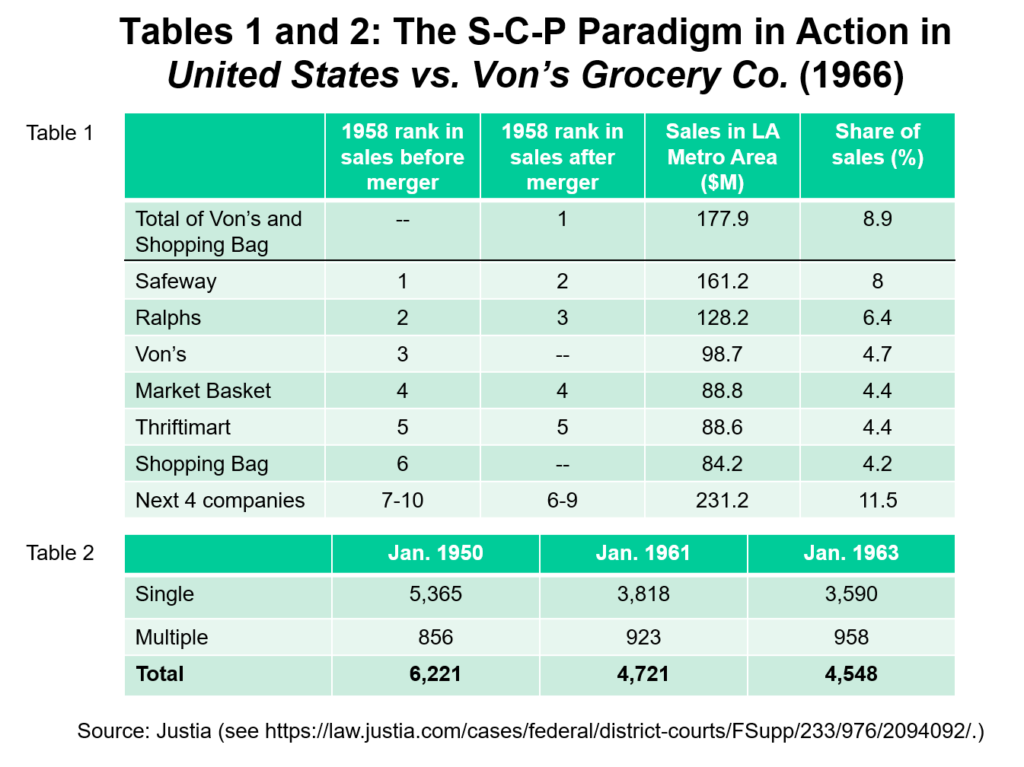
I wonder where LA is today on this measure? It certainly feels like the S-C-P model got the basic trend right. The top ten grocers collected nearly 44% of that metro area’s revenue in ’58, and I’d bet dollars to donuts that the top ten grocers in and around LA will collect a higher share of revenue than that this year.
Once you get past the challenge of defining a market’s boundaries, the mature S-C-P paradigm offered a straightforward means of judging the merits of a proposed merger. In United States vs. Von’s Grocery Co., the court determined the LA metro area was an “appreciable trade area” since the people there shelled out ~$2.5 billion a year on groceries in the late ’50s.48 One a market is bound and ruled to be economically significant, the next step is to figure out the top dogs’ annual revenues and calculate their associated revenue shares, and then come up with the historical trendline on large agent revenues and market shares (using the most accurate data and the most objective scientific process available). That all points you in the direction of a thumbs up or thumbs down verdict on proposed mergers. That process had the Supreme Court’s stamp of approval in the ’60s.
Case study #3 is United States vs. United Shoe Machinery Corp. (I doubt the Supreme Court had a grudge against footwear businesses in the ’60s; my case selection was solely, no pun intended, based on what I ran across first in my research.) United Shoe had a 75% share of the domestic shoe-making machinery business. The company’s products were only made available through long-term lease agreements that effectively froze out the competition. That practice violated Sherman in the eyes of the plaintiff, the United States, and Supreme Court concurred in 1968. The court ordered United Shoe to make its hardware available for sale as well and barred it from certain patent practices for good measure.49
United Shoe was crooning “Hello, I Love You” into the ears of its locked-in customers until it felt “The Good, the Bad and the Ugly” sting of the Supreme Court’s six shooters in its hind end. This legal context puts us right on the doorstep of the “Neal Report.”
♦
Commissioned by President Johnson in ’67 when he still planned on running for president the following year, the “Neal Report” was intended to be an element of Johnson’s and the Democrats’ campaign platform. Formally called the “Report of the White House Task Force on Antitrust Policy”, the report’s nickname came courtesy of the task force’s leader, Phil C. Neal, who was dean of the University of Chicago’s Law School at the time. The report came out in early ’69 despite Johnson deciding not to run and Nixon ascending to the White House, and its contents have been all but lost to the sands of time.50
The “Neal Report” recommended that the federal government:51
- Pass a Concentrated Industries Act making it the duty of the Attorney General and the FTC to investigate the structure of markets that appeared to be oligopolistic. “The purpose of such legislation would be to give enforcement authorities and courts a clear mandate to use established techniques of divestiture to reduce concentration in industries where monopoly power is shared by a few very large firms.” The best available research, the authors concluded, showed that “Industries in which four or fewer firms account for more than 70% of output produce nearly 10% of the total value of manufactured products; industries in which four or fewer firms account for more than 50% of output produce nearly 24%. An impressive body of economic opinion and analysis supports the judgment that this degree of concentration precludes effective market competition and interferes with the optimum use of economic resources…” The goal of the Act would be to reach a “reduction of concentration such that the market share of each oligopoly firm in such oligopoly industry does not exceed 12%” within four years of a market being deemed oligopolistic by the DOJ and FTC.
- Pass a Merger Act that barred large firms in concentrated industries from acquiring other large firms in the same or another market. This would enhance Clayton by forestalling additional “conglomerate” mergers. “If large firms are prevented from acquiring leading firms in concentrated industries, they will seek other outlets for expansion which may be more likely to increase competition and decrease concentration,” the authors found. The proposed legislation defined large and leading firms based on their revenue and market shares and should state that, “No large firm shall directly or indirectly merge with, combine with, or acquire any equity security in any leading firm…in any market in which it is a leading firm. [And no] leading firm shall directly or indirectly merge with, combine with, or acquire any equity security in any large firm or directly or indirectly acquire all the assets of a large firm or a part thereof sufficient to constitute a large firm.” Bing, bang, boom, bye-bye M&A processes that produce a new, dominant players in large industries. Sounds mighty Brandeisian.
- Revise the Robinson-Patman Act in order to “remove features that unduly restrict the free play of competitive forces.” The authors recommended watering down that part of existing law because the “purpose of the Robinson-Patman Act is to eliminate price discrimination that unduly favors national over local sellers or confers unjustified advantages on large purchasers merely because of their size. But not all price differentials represent discrimination and not all discrimination is undesirable…Our proposed revision is intended to leave room for price behavior which is related to the improved functioning of the competitive system.”
- Update patent laws so that “a patent which has been licensed to one person shall be made available to all other qualified applicants on equivalent terms.” The authors maintained that, “An important goal of antitrust policy is to prevent the use of a patent by the patentee in collaboration with others to create a monopoly broader than the patent itself. That goal will be served by denying the patentee the right to confine use of the patent to a preferred group and requiring that if the patent is licensed it shall be open to competition in its application.”
- Give the Census Bureau and other agencies more power to collect key market data so that future antitrust actions may be better informed. The authors pushed for the creation of a standing interagency committee that would consider how to improve “the gathering and presentation of economic information within the statutory limits on disclosure of information on individual firms”, consider how to interpret “existing law or, eventually, new legislation to minimize restrictions on disclosure of types of information which are not highly sensitive”, and to build the “machinery for developing information on the competitive structure of relevant economic markets.”
The “Neal Report” was porn for S-C-P fans.52 Its recommendations had a clear line back not just to the post-war work of Areeda-Turner Harvard school economists, but to earlier generations of fans of highly-competitive capitalism, including Brandeis, Keynes and their fellow #progpop travelers. Read this excerpt from the report’s body and tell me isn’t a lightly edited update of the case for capitalism that was first laid out by Adam Smith in 1776:
High profit rates in individual firms or even in particular industries are of course consistent with competition. They may reflect innovation, exceptional efficiency, or growth in demand outrunning the expansion of supply. Above average profits in a particular industry signal the need and provide the incentive for additional resources and expanded output in the industry, which in due time should return profits to a normal level. It is the persistence of high profits over extended time periods and over whole industries rather than in individual firms that suggests artificial restraints on output and the absence of fully effective competition. The correlation of evidence of this kind with the existence of very high levels of concentration appears to be significant.
By all means, let’s enjoy the capitalist party but let’s also remain vigilant against monopolies because they’ll drop a deuce in the punchbowl if they get the chance. Adam Smith knew that efficient, market-based economies must strike a tough balance. The Arrow-Smith ideal is a tripartite balance involving individual liberty (agent freedom), systemic economic efficiency (a key long-term aim of good governance), and social justice (there must be limits on the range of socioeconomic outcomes experienced by flesh-and-blood people because extreme inequality undercuts both individual liberty and systemic efficiency, and it’s immoral to boot). Fat, consistent profit margins in large industries are a huge red flag that competitive dynamics aren’t strong, that customers are getting gouged on price and that vendors may be colluding. The invisible hand can’t move in a vendor locked market.
Is there direct evidence that the S-C-P power lifting that happened after World War II moved the needle on the Arrow-Smith ideal? In word, yes. Figure 21 illustrates the point. U.S. household net worth shares between 1913 and 1970 are split into three segments in the figure: top 1% wealthiest households, the next 9%, and the bottom 89% of households. Data are courtesy of the same World Inequality Database used in Figure 19.53
In the 1945-1970 period, U.S. wealth shares got more stable than they’d been in the World War I to World War II period, and the net wealth share trend was away from the top 1% in the post-World War II years. That’s what one would expect in a nation moving in the direction of the Arrow-Smith ideal. The top 1% of households lost >6% of relative net worth between 1945 and 1970, and the other two segments each gained about 3%. The U.S. economy exploded after World War II as well, so the relative top 1% drop wasn’t an absolute drop – the rich still got wealthier.

Correlation isn’t causality but let me posit something that we’ll come back to in Chapter 4, and recheck based on what’s happened since 1970: when the nominal income tax rates on America’s top 1% households and on its biggest corporations were higher from World War II through 1970 and when the S-C-P approach to antitrust enforcement was dominant, household net worth shares trended away from the top 1% and toward the upper middle class household and, to a modest extent, toward the bulk of America’s middle class and poor households. That’s what movement towards the Arrow-Smith ideal looks like: stable growth and a narrowing of the range of socioeconomic outcomes across the population of market agents.
Nixon shelved the “Neal Report”. He commissioned his own study on antitrust and how related policies might be improved. This time, University of Chicago microeconomists were put in charge of the process. They had a radically different take on antitrust, and let’s just that say laissez-faire was about to go back on the menu.
♦
In the spring of 1947, two months before George Marshall laid out the Marshall Plan on Keynesian lines at Harvard, Friedrich Hayek invited about three dozen economists, historians and philosophers to a resort overlooking Lake Geneva in the Swiss Alps. Hayek wanted to establish an international organization that would resist state intervention in economic affairs and to rescue his view of classic liberalism from the advancing, muscular tentacles of Keynesianism.54 Hayek categorically rejected Keynesian economics. In a 1983 interview, Hayek dropped this genteel deuce in Keynes’ lap: “I am claiming that perhaps the most impressive intellectual figure I have every encountered and whose general intellectual superiority I have readily acknowledged, was wholly wrong in the scientific work for which he was chiefly known.”55
The New Deal and Keynes’ active government prescription for what ailed economies in a recession – increases in demand-oriented spending and a stiffening of the regulations aimed at real or perceived anticompetitive practices of big businesses in particular – was viewed by those present as one part of a spectrum that ended in totalitarianism and/or Russian communism. The Mont Pelerin Society was born out of this conference.
Those present settled on the term neoliberal to describe their philosophy. The term had been floating around for a few decades and vaguely circumscribed the conviction that deregulatory, laissez-faire governance norms and free-market capitalism could solve most if not all economic and social problems.56 To minimize confusion, and because a key premise of this ebook is that classical liberalism started with Adam Smith and culminated in the Arrow-Smith competitive ideal that was best captured in the mid-20th century by Ken Arrow’s and Gérard Debreu’s general equilibrium theory, we’ll instead posit that members of the Mont Pelerin Society belong to the libertarian tradition. They and Albert Nock certainly saw eye to eye on many things. Hayek’s The Road to Serfdom, first published in 1944, is also one of the purest laissez-faire libertarian screeds ever penned.57
Founding members of the Mont Pelerin Society included Hayek, Frank Knight, Karl Popper, Ludwig von Mises, George Stigler and Milton Friedman.58 All these men are associated with the libertarian ideology and several self-identify as libertarian. Their society has convened annually from 1947 onward, albeit with more big business executives on hand in recent decades. The Mont Pelerin Society is today helmed by John Taylor, a professor of economics at Stanford and a senior fellow at Stanford’s Hoover Institution, a think tank with long-standing ties to conservative libertarianism.59)
Members of the Mont Pelerin Society agree, then as now, that libertarianism – the belief that a near zero sum game exists between individual/business socioeconomic power and governmental socioeconomic power, and that investments in the former invariably produce larger gains than investments in the latter – and free-market fundamentalism – the belief that unfettered business activity can meet virtually all social and economic needs rapidly and efficiently – are the proper route forward for all market-centric societies.
Let’s be clear about something else while we’re at it: Mont Pelerin Society members started with these convictions and have backfilled math, logic and history ever since to support their preordained conclusions. Chapter 4 will offer ample evidence of their intentional rewritings of history and extremely dubious math and logic. For now I’ll simply posit that Mont Pelerin Society members agreed to break the scientific process right off the bat, and have taken a vow to minimize and ignore every bit of evidence that doesn’t support their preferred endpoints.
World War II appears to have opened a deep geopolitical gash in the economics profession that’s never healed. Different schools of thought have always existed in economics of course, as in practically every other field of social and scientific investigation. What’s made post-World War II libertarians different is that when math and logic suggest there are deep flaws in their theories and when real-world measurements show that the implementations of their theories deliver huge socioeconomic downsides (negative multiplier effects), they just dig in deeper, like ticks, and stick their fingers deeper into their ears. Libertarianism is a quasi-religion masquerading as a science. Chapter 4 will show this as well.
Hayek, Knight, Stigler and Friedman all spent large chunks of their careers in the economics department at the University of Chicago. These Chicago School economists, and all their fellow travelers since World War II, are, in effect, the Mont Pelerin Society’s U.S. branch. Knight mentored Stigler and Friedman, and the seeds of Knight’s libertarianism can be traced back at least as far as a 1921 book, Risk, Uncertainty and Profit. Knight’s book venerates the role of entrepreneurs in capitalist societies and decries public (governmental) market intervention.60 Like Friedman, Stigler eventually won a Nobel Prize in economics. Stigler got his Ph.D. in economics from the University of Chicago as the Great Depression wound down, and he became president of the Mont Pelerin Society in late 1970s. Friedman was president of the organization in the early ’70s.
Stigler is best known for his work on regulatory capture.61 The premise here is that the government’s apparatus for regulating and overseeing corporate activity is often, if not always, overwhelmed and captured by the very companies its designed to regulate and rein in when they exhibit anticompetitive behaviors, and that this power is often converted by corporations into a weapon that’s wielded against their competitors and society at large. So far so good. The Chicago School’s prescription for fixing this very real concern and danger to efficient capitalism, though, is to drastically pare back or entirely scrap the government’s oversight operations.62 That’s peachy. You’ve identified a fox in the henhouse problem and your solution is to burn down the henhouse and tell the farmer to go fuck himself.
Stigler was who got tapped to head up Nixon’s task force that reviewed the state of U.S. antitrust policies. His team’s terse response to the “Neal Report” – it clocked in about 1/8th as long as the “Neal Report” – was leaked in mid-1969 and has been dubbed the “Stigler Report”. Guess what? Stigler and his comrades found reasons for the government to take its foot off the antitrust enforcement gas pedal. What a shocker. Formally called the “Report on the Task Force on Productivity and Competition”, Stigler et fired a broadside against the entire S-C-P model and everything that led up to it in the Progressive Era and through FDR’s New Deal response to the Great Depression.
The authors of the “Stigler Report” recommended the DOJ do the following:63
- Stop breaking up the leading firms in “oligopoly” industries. “We cannot endorse, on the basis of present knowledge of the effects of oligopoly on competition, proposals, whether by new legislation or new interpretations of existing law, to deconcentrate highly concentrated industries by dissolving their leading firms.” Their main piece of advice, as it related to “horizontal” mergers, which is when companies seek to buy their direct rivals, and for “vertical” mergers, which is when companies seek to buy a supplier or a customer, was for the government to simply drop its antitrust hammer.
- Take its foot off the gas as it related to preventing conglomerate mergers. “The Department of Justice Merger Guidelines are extraordinarily stringent, and in some respects indefensible. We suggest a number of revisions in the accompanying Report. We strongly recommend that the Department decline to undertake a program of action against conglomerate mergers and conglomerate enterprises, pending a conference to gather information and opinion on the economic effects of the conglomerate phenomenon.” The authors recommended that the government stop pursuing conglomerate merger cases, which is when companies in unrelated markets seek to unite, until the government researched the competitive effects of such mergers more fully, although the text also makes clear that the authors are quite skeptical that conglomerate mergers are a problem.
- Refocus on penalizing price-fixers. “We recommend that the Department bring a series of strategic cases against regional price-fixing conspiracies, which we believe to be numerous and economically important…[We] urge the Department to maintain unremitting scrutiny of highly oligopolistic industries and to proceed under section 1 of the Sherman Act – which in our judgment reaches all important forms of collusion – in instances where pricing is found after careful investigation to be substantially noncompetitive.” This is an area where the authors argued for more vigilance over big business activities as well as stepped-up penalties, although price-fixing cases are generally very tough to prove and so, in a sense, they’re recommending that the government refocus on something that’s very hard to do.
- Make its antitrust decrees that apply to companies self-repealing. “The Department should not seek the entry of regulatory decrees, decrees that envisage a continuing relationship with the defendant. Save in exceptional circumstances, all decrees should contain a near termination date, ordinarily no more than 10 years from the date of entry. And the Department should undertake a review of existing decrees to determine which should be vacated as obsolete or inappropriate.” Instead of barring offending companies from certain activities indefinitely, all DOJ decrees should automatically “go poof” within a decade no matter what that company’s done in the interim.
- Water down the Robinson-Patman Act and repeal the Expediting Act. Regarding Robinson-Patman,first the authors wanted its “general prohibition against price discrimination” weakened (they preferred that subsection to “be made more supple by broadening the meeting competition and cost justification defenses…”), and secondly, they wanted three other subsections dealing with the “more absolutist brokerage and promotional payments and services prohibitions” repealed in their entirety. The Expediting Act had to go because without the benefit of the “winnowing and focusing process involved in an intermediate appeal” the Supreme Court, in the authors’ view, had been rendering many “low quality” antitrust verdicts. They wanted the oligopoly company dissolution process brakes pumped.
Stigler et al acknowledged the DOJ and FTC partially existed “to prevent monopoly pricing (as with telephone and pipelines); to prevent congestion (as with radio and television frequencies); to provide safety to savers (as with financial institutions); and so on.” When it came to the predominant S-C-P model of antitrust enforcement, though, these agencies were going too far. The authors stated that it appeared “to be true that somewhere between five and ten effective rivals (i.e., a largest firm with a share of 1/3 to 1/5) are usually enough to insure substantial elimination of the influence of concentration upon profitability.”
Rather than bringing suits against firms with <10% market share, Stigler and company were comfortable when the top dogs in large industries got 20% or even 33% of total market revenue. The weakening of antitrust laws is a core piece of the libertarian vision for society. The contrast with the “Neal Report” is stark, and plainly stated in black and white. The latter report sought a max market share of revenue of 12% for oligopoly firms in oligopoly industries. Stigler and company wanted those goalposts moved back at least 40% and as much as 64%. No wonder big businesses that want to buy other big businesses have tacked toward laissez-faire libertarianism since the Nixon administration.
The “Stigler Report” also asked for an interesting bit of math to accompany any attempt to break up price-fixing top dogs. “In assessing the gain from such structural remedies [i.e., using Sherman to dismantle collusive top dogs], account should be taken of any reduction in efficiency which the remedy entails.” Say wha? Stigler et al were positing that the economy of scale upsides and related advantages that accrue to big businesses were so vast that by breaking them up, the government was introducing inefficiency into the market and it should estimate the associated hit the market would take. This is a full break with the Arrow-Smith ideal. Instead of more competitors and a finer breakdown of market shares correlating with improved market efficiency, Stigler and company held that the opposite was true. All aboard! The train to Brooks Adams’ and George Perkins’ monopolyville is leaving the station.
Regarding mergers between competitors (horizontal mergers), the report first sketches an extreme S-C-P case. For example, “If a market is ‘highly concentrated’ (defined as where the 4 largest firms account for at least 75 percent of the sales in the market), then a merger between two firms, each of which has a 4 percent market share, will be challenged; and if the acquiring firm has a share as large as 15 percent, then the acquired firm need have only a 1 percent share for the merger to be challenged. Different levels of permissible size are stated for less concentrated industries, and some account is taken of the trend of concentration.” So far so good. Stigler et al captured the basic S-C-P formula, although the authors cited zero cases in which the government brought a suit that met those criteria.
Stigler and company followed this by writing that they’d “favor levels of concentration modestly lower than those now used (but differently structured), with the purposes of (1) allowing all mergers below the Guideline levels, and (2) not prohibiting, but reviewing, those above the critical level, with an implied probability that the more a proposed merger lies above the level of automatic approval, the less the probability of its acceptance.” Anyone else sensing some razzle-dazzle fancy footwork here? The authors first suggest the government should nominally tighten S-C-P concentration ratio guidelines and then attach a giant rider to it that throws the door back open to more mergers between large, direct competitors.
Let’s pause to appreciate this libertarian two-step: we want you to take something simple and make it far more complex – introduce a huge legal grey zone into the existing process – and then we want you to imply a superficial strictness increase while, in fact, giant cracks (more “suppleness”?) are introduced into the merger guidelines so that more big biz mergers in fact make the cut. The introduction of legal grey zones and deceptive marketing practices are quintessential tools in the libertarian toolkit, as Chapter 4 will amply demonstrate.
The “Stigler Report” hems and haws on high versus low barriers to market entry, on the importance of demand elasticity (whether lots of similar products are available), follows up that with some fancy footwork which implies that the main competitors in oligopoly markets other than top dog should be treated as if they were much larger from a concentration ratio calculation perspective than they actually are as measured by their revenue shares, and then, at long last, lands its pirouette and states that it would “be a decided improvement if the Guidelines were revised (at a minimum) to explain that a distant seller of a product must be included in the local market if a modest price increase in the local area – a price increase unrelated to his costs – would bring him in forthwith.” That math is left vague, as usual, but the clear implication is that the authors’ recommendations, if enacted, would allow many more horizontal mergers than the S-C-P model allowed, partly because the “Stigler Report” authors wanted the definition of a market widened.
The report’s authors were blunter on the topic of vertical mergers. “Our Task Force is of one mind on the undesirability of an extensive and vigorous policy against vertical mergers: vertical integration has not been shown to be presumptively noncompetitive and the Guidelines err in so treating it…[Our] positions coalesce on one policy conclusion: vertical mergers should not be forbidden as a class.” Ditto on conglomerate mergers. “We seriously doubt that the Antitrust Division should embark upon an active program of challenging conglomerate enterprises on the basis of nebulous fears about size and economic power…Vigorous action on the basis of our present knowledge is not defensible.” Bing, bang, boom, hello more beautiful big businesses.
Nixon soft-pedaled the “Stigler Report” at the end of the day. Its primary near-term impact was to muddy the antitrust reform waters. Whatever momentum existed for tightening antitrust rules and enforcement policies along S-C-P lines in the Johnson administration, that momentum stalled under Nixon. The “Neal Report” and the “Stigler Report” fought each other to a draw, in effect, and neither recommendation set was acted upon immediately.
Chinks in the S-C-P dike began leaking water in the mid-1970s. Congress repealed the Expediting Act in 1974.64 A trickle of pro-libertarian change would soon become a flood. Few recognized it in 1970, but the tide had turned. Chicago School economists and their acolytes were about to go on a long winning streak that in many respects hasn’t yet abated. Classical liberalism, and the Arrow-Smith ideal, has been on defense since the mid-1970s. Many of its norms have been sent “floating this way and that like haycocks in a flood” since that point. America’s rising tide of laissez-faire libertarianism has brought something else along with it, though, that’s as dangerous as it was predictable to those who grasped the basics of the mid-20th century #progpop philosophy: rising socioeconomic inequalities.
References
