Inflation is always and everywhere a monetary phenomenon.
– Milton Friedman
The Organization of the Petroleum Exporting Countries (OPEC) embargoed oil exports to the United States in 1973, triggering an unusual economic phenomenon that became known as stagflation. OPEC was and remains mainly comprised of Middle Eastern and North African oil producing states like Algeria, Iran, Iraq, Kuwait, Libya, Nigeria and Saudi Arabia.1 The embargo was imposed because OPEC viewed the U.S. and a handful other nations as key backers of Israel during the Yom Kippur War (in which Egypt and Syria led an Arab coalition against Israel).2 The war began and ended in October of 1973, with Israel victorious, and OPEC’s retaliatory oil embargo started that month.
The crude oil shortage induced far-ranging negative effects in embargoed countries. The nominal price of a barrel of oil in the U.S. nearly quadrupled, from around $3 prior to the embargo to nearly $12 after the embargo ended in March 1974.3 The price of gallon of regular gas jumped by almost 45% between mid-1973 and the following summer.4 Long lines appeared at gas stations due to shortages and, per President Nixon’s request, nearly all gas stations closed between Saturday evening and Monday morning. Millions of proto-disco fans had to stay home on weekends and endlessly listen to The O’Jays’ “Love Train” on vinyl records and 8-track tapes. It was a profoundly frustrating time.
The inflation-adjusted price of oil remained close to 2x what it had been before the embargo long after it ended. Oil and gas aren’t only critical for heating homes and powering vehicles; they’re critical inputs into a wide range of business and social processes, and that was probably even more true in the early ‘70s than today since battery tech was limited and far less pervasive at that point. Factories needed power, offices needed lights, and almost everything plastic was and still is made from petroleum.
Inflation had already ticked up between 1968 and 1972 (U.S. inflation ranged from 3.2% to 5.7% per year in this period, after averaging <3% early in the ‘60s), and part of inflation’s rise circa 1970, many economists agree, was because America had grown increasingly dependent on pricier foreign oil, although some economists hold that the costs of the Vietnam War costs and an expansionary monetary policy by the Federal Reserve contributed to rising inflation.5
What followed was materially different. Inflation increased to 7% in the last months of 1973 and it averaged a whopping 11% in 1974.6 America fell into a recession in late 1973 to boot, a recession that wouldn’t end until early ’75; unemployment simultaneously rose as the stock market took a beating.7 All of these sudden, negative shocks soured the nation’s mood, especially since standards of living had been rising fairly consistently across the board in America since the end of World War II. It was rude awakening of sorts. There had been four recessions in the 1950s and ‘60s but they’d all been relatively short and mild. The recession of 1973-1975 was deeper and longer. By the end of ’74, a large swath of the American public had lit and raised torches and pitchforks that had gathered dust in basements and attics since the Great Depression. Something had to be done, pronto.
In a typical recession, prices fall because demand declines and businesses accumulate excess inventory, leading to price cuts in order to buttress sales. Early in the Great Depression, for example, between 1930 and 1933, America’s annual inflation rate ranged between -2.3% and -9.9%, and GDP growth ranged from -1.2% to -12.9% a year.8) This didn’t happen in the recession following OPEC’s oil embargo. Inflation spiked and the price of many goods/services rose as the economy shrank – a historically very rare occurrence, and a painful double whammy for millions of middleclass and working poor households and families especially. This unusual combo is what got dubbed stagflation. Inflation hadn’t hit 10% in any year since shortly after World War II.
A British economist and author named Tejvan Pettinger captured what made this recession different (the UK experienced stagflation circa 1974 for the exact same reason). The recession, Pettinger wrote, was caused by cost-push factors, which, in this case, was the sudden tripling of oil prices. “Cost-push inflation occurs when we experience rising prices due to higher costs of production and higher costs of raw materials: a supply-side bottleneck of a core economic input like oil. Cost-push inflation is determined by supply-side factors, such as higher oil prices or a big jump in wages. In this case, it was caused by a foreign oligopoly flexing its muscles to punish the U.S.”9 OPEC sought to punish Israel’s allies and they did so.
As America struggled to pull itself out of stagflation and leave the quagmire behind it, it recurred. The second oil crisis began with the Iranian Revolution of 1979 (president Jimmy Carter imposed a U.S. embargo on Iranian oil after revolutionaries there stormed the U.S. embassy in Tehran and took 52 hostages), and the oil shortage grew more acute once the Iran-Iraq war broke out the following year.10 Both of these latter OPEC producers nearly zeroed out exports for much of that war, which dragged on until 1988.11 1973’s long lines at the gas station returned with a vengeance at the end ‘79, this time pissing off drivers and passengers decked out in full Saturday Night Fever regalia.
The far-reaching effects of these twin oil shocks are self-evident in figure 23. America’s annual unemployment and inflation rates are scaled on the figure’s left-hand axis, and came from the Bureau of Labor Statistics (BLS).12 The right-hand axis shows the per-barrel price of West Texas Intermediate (WTI) crude, which was a decent proxy for U.S. oil prices generally in the 1970-1985 period. Oil prices in the figure are inflation-adjusted (they’re “real” prices), reflect the average price per barrel in December of each year, and were sourced from Macrotrends by way of an Investopedia article.13
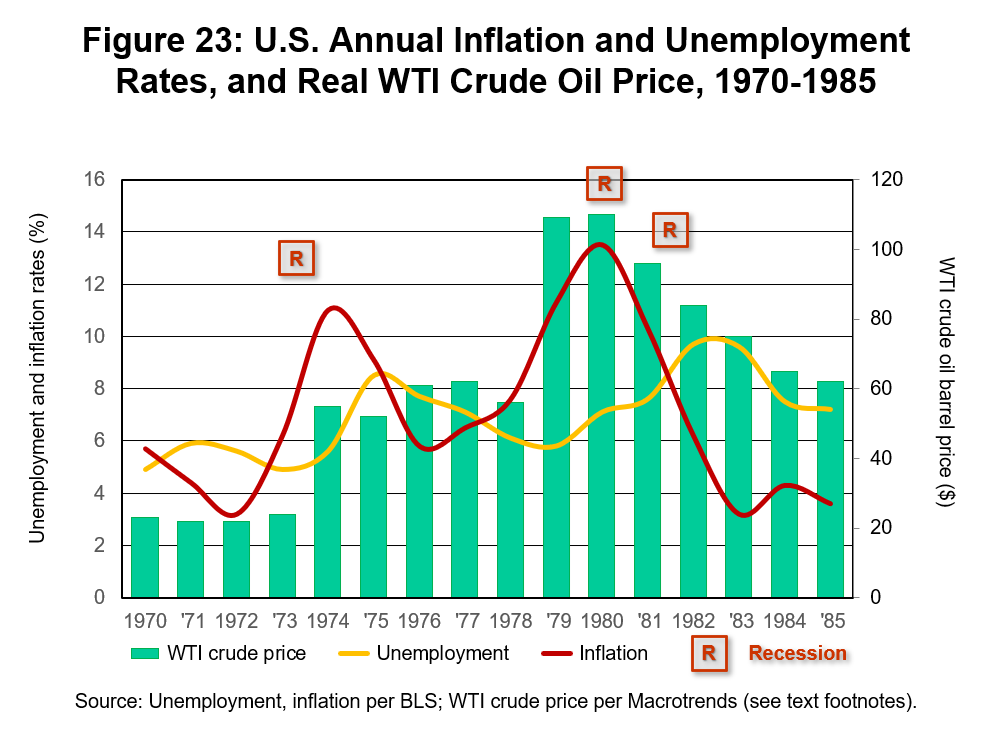
The correlation between rising crude oil prices and rising inflation, shown in figure 23’s green columns and red line, was fairly strong in the 1970-85 period. It’s worth stressing that this was the only time in U.S. history in at least the past century in which stagflation reared its ugly head. The relationship between the onset of the recessions, represented by the red boxed R’s in the figure, and spiking crude oil prices is also clear. We’ve mentioned the recession that kicked off in late ‘73, but another short recession began in early 1980, which came on the heels of the Iranian Revolution (a downturn we’ll come back to shortly), then there was a brief recovery, then another recession hit in mid-1981 that lasted until late ‘82. Such recessions are logical consequences of big cost-push factor changes, and America’s spiking oil prices qualified in this regard.
America’s unemployment rate, shown in figure 23’s gold line, lagged the crude oil price and inflation rate changes in this period but it followed the same basic pattern. Many companies don’t feel the pinch of recessions for a few months and may wait several more months before laying off workers. There was an 18- to 24-month lag between the twin inflation spikes (and the onset of recessions) and the twin peaks of U.S. unemployment in the 1970-85 period, but unemployment did tick down afterwards in rough relation to the decline in the inflation rate and WTI crude oil prices. A clear macroeconomic pattern emerged in this period.
L-f-lib ideologues jumped on stagflation and used as a weapon against the Keynesians. Ironically, OPEC’s collusion on the embargo as well as its overt price-setting process – a process that most l-f-lib’s would deny has an analog on U.S. soil in subsequent decades – was twisted in the 1970s into a domestic rationale for rolling back Keynesian-oriented policies and shredding parts of the S-C-P paradigm that reinforced competitive dynamics at the apex of many U.S. industries. The l-f-lib fairy tale version of what went down is that Freidman and company, wielding shiny new monetarist swords, galloped in on white stallions in the late 1970s and battled and subdued the stagflation beast as the Keynesians looked on in slack-jawed awe. The reality was far muddier, which is exactly how l-f-lib’s prefer things to appear.
♦
Milton Friedman was a chief economic advisor to Barry Goldwater during his 1964 run at the presidency. Many of Goldwater’s speeches that touched on economics had a pronounced l-f-lib bent to them that came straight from Friedman.14 Goldwater went on to become the GOP’s nominee that year but was trounced in the general election by Democratic incumbent Lyndon Johnson. Goldwater received <39% of the vote and carried only six states: his home state of Arizona and five states in the Deep South.15 Goldwater’s opposition to the Civil Rights Act of 1964 helps explain his strong showing in the South.
Goldwater was a Friedman-esque libertarian, which meant that his appeal to Republicans nationally was limited at that point. Goldwater wasn’t a fan of televangelists like Pat Robertson, who were making inroads into the GOP in this timeframe and converting it from a secular political organization into a Christian-first party; Goldwater believed that homosexuals should be able to serve openly in the military, he supported women’s rights on the then-nascent abortion issue, and he argued that weed should be legal for medicinal purposes.16 The only major piece of Friedman’s political philosophy that was absorbed by the broader GOP after Goldwater’s body slam in ’64 was his anti-federal government, and more specifically, his sharply anti-Civil Rights Act stance, which was charged with profound racial potency.
The GOP left the rest of Friedman’s l-f-lib philosophy behind like the (liberal) roadkill it largely was. Actual Libertarian Party candidates for president typically get <1% of the national vote. That’s because if you take their anti-government viewpoints seriously, you wind up in Goldwater turf. If you truly believe in limited government, that means the government should not decide where the buck stops on abortion rights, LGBTQ rights, drug use, prostitution, military conscription, capital punishment and many other issues. Goldwater was a sui generis libertarian. Never before or since has a candidate with his set of beliefs come anywhere near winning the White House.
The main long-term consequence of Goldwater’s run was that libertarians’ hand-off, states rights approach to racial inequity matters was embraced by the GOP. Friedman was no dummy. By 1968, he’d already climbed onto Dick Nixon’s GOP campaign bandwagon.
A key piece of advice that he gave candidate Nixon was to let the dollar float freely on international exchange markets. The U.S. had recently shifted from being a net exporter to being a net importer, and Freidman argued that by letting the dollar float free, the nation could rid itself of its growing negative balance of payment problem.17
Nixon squeaked out a W in ’68, and his administration promptly followed Freidman’s advice. The U.S. failed to swing back into sustained trade surpluses in the 1970s, however.18 What Friedman accomplished with this action was to take out key struts that underpinned the Bretton Woods Agreement, which soon disintegrated.
Paul Volcker helped bury Bretton Woods as well. Volcker had studied public policy and international affairs at Princeton and gotten a masters in political economy from Harvard in ‘51.19 For most of the next two decades, he bounced between various jobs at Chase Manhattan Bank, the Fed’s New York branch and the Treasury Department. Nixon tapped Volcker to become undersecretary of the Treasury for international monetary affairs in ‘69, a role he’d remain in until Nixon resigned after the Watergate scandal.20 It was in this role that Volcker was instrumental in allowing the dollar to float freely.
Somewhere in this process Volcker got bitten by the monetarist bug. He ascended to the chair of the Federal Reserve in mid-1979, and so was ready, willing and able to use the monetarists’ playbook in order to counter stagflation, which reared its ugly head (again) late that year. Volcker’s Fed clamped down hard on the money supply in the waning months of ‘79.
After wandering in the wilderness for half a century, Ronald Reagan and the GOP chalked up a huge win for conservatives in the 1980 election cycle. Reagan got just 51% of the popular vote, but Carter ultimately carried fewer states than Goldwater.21 Reagan held Volcker over at the Fed, and the fallout from his employment of the monetarists’ strategy was soon apparent: interest rates spiked to double-digits as the money supply dried up, and consumer and business borrowing fell off a cliff in consequence.22 Cause and effect. The U.S. was in recession by January 1980.
Practically anyone who’s reviewed the episode agrees that the short but deep recession of 1980 was induced by the Fed’s overtightening of the screws on the money supply.23 In December 1979, America’s inflation rate was a whopping 13.3%. By August of the following year, inflation fell back under 13% and kept falling from there. Correlation isn’t causality, but one can credibly posit that Volcker’s main strategic objective in this period, to tame inflation, was accomplished by employing the monetarists’ strategy. It’s equally clear, though, that his initial clampdown on money drove the economy right into a ditch.
Let’s also not forget the cost-push factor alternative explanation for the demise of stagflation, however: the price of crude oil started to decline again in late 1980 and it kept falling year-on-year from there through at least 1985 as more oil producers stepped up their output to take advantage of elevated prices.24 This also correlates to the decline in the inflation rate and the end of stagflation.
Friedman, Reagan and the l-f-lib’s would have none of the latter explanation. Lavish praise was heaped on Volcker’s Fed, and Friedman by extension, starting in late 1980 for having brought the inflation beast to heel. The episode was interpreted as a vindication of monetarism. Its supporters basked in the warm glow of public praise and high fived each other on a victory lap. If monetarism was wise policy, the next question became, were the Keynesians also wrong about other things? The tide turned outside the economics profession in 1980, and Keynesian economists and associated G.E. theory proponents increasingly found themselves on defense for the first time since at least the Great Depression.
Monetarism holds that if one multiplies the money supply by velocity, the rate at which money changes hands, that equals nominal spending in an economy. Defining what money counts and what constitutes velocity, though, turns out to be a lot harder than it sounds.25 We’ll revisit this topic in chapter five, but the key point at present is that even Milton Friedman would keep dancing around these questions for the rest of his career and never settled on a definition of money and velocity that yielded a model that consistently tracked to the U.S. economy. Monetarism looks good on paper but never added up in the real world.
We’ve noted that Friedman and Schwartz built wiggle room into their model in A Monetary History. For monetarism to hold water, velocity has to remain fairly stable (it has to change slowly). It follows that nominal incomes/wages are linked to the money supply, and so have to change slowly too.26 Monetarists also maintain that markets are inherently stable, so if the central bank simply increases the money supply 3% to 4% per year, in order to keep pace with broader inflation, that prescription should be enough to keep market-based economies on track. This is the connection between monetarism and the l-f-lib ideology: if monetarism is right (an accurate measurement and prediction tool), then governments need very few other tools in their toolboxes to keep the milk and honey flowing to citizens and businesses. If governments do a lot, per this view of macroeconomics, when they’re proactive and “meddle” in markets as “welfare states” often do, then there’s more socioeconomic harm done than good.
Keynesians rose to defend their honor in the ‘80s. They countered that rising demand has been, and remained the fundamental driver of economic growth, and that changes in the money supply are a relative sideshow.27 Keynesians produced evidence that velocity wasn’t always stable and that wages/incomes aren’t always “sticky” or slow to change either. They reaffirmed their belief that markets can indeed be highly-unstable and that handcuffing federal responses in a crisis to the activities of the central bank alone was risky, dangerous and misguided.28
The l-f-lib’s shouted the Keynesians down. They concocted the Philips Curve myth to help speed the process. This was Freidman’s third rewriting of history job, and by this point his acolytes had grasped the concept and were getting good at it as well. This rewrite began after America’s first bout with stagflation and was kicked into hyperdrive after its second bout.
The Philips Curve myth, simply put, is that a New Zealand-born economist named William Phillips published a landmark paper in 1958 that appeared to show a negative relationship between inflation and unemployment. Influential Keynesians, such as Paul Samuelson and Robert Solow, ran with Phillips’ idea, and by the 1960s, the myth continued, numerous governments in the grip of the Keynesians were making policy choices based on a perceived tradeoff between inflation and unemployment. Freidman and others then rode in on white stallions (again) in 1967-68 to prove this tradeoff was false, and after a kerfuffle, the Keynesians backed down and slowly 1967-68 to prove this tradeoff was false, and after a kerfuffle, the Keynesians backed down and sulked away to lick their wounds in the ‘70s and early ’80s.29
An examination of this entire episode was detailed in James Forder’s 2014 book, Macroeconomics and the Phillips Curve Myth. Forder, another English economist, reviewed all of the relevant papers, examined the public policy choices and related explanations from multiple governments through this period, and the results of his exhaustive research was distilled in this book.
Keynes never claimed wage/income inflation and unemployment always inversely corelated, by the way, so his alleged “defeat” was a stretch right off the bat. Second, Phillips’ 1958 paper, which involved wage and unemployment trends over time in Britain, was hardly an instant classic. Forder’s research revealed that the paper was infrequently cited in the decade after its publication and that it wasn’t until the end of the 1960s that the term “Philips Curve” began to appear in academic literature. Third, related works by Samuelson and Solow never claimed that inflation went up as unemployment went down or vice versa and, perhaps most importantly, there’s precious little evidence that governments actually acted as if this tradeoff was real.30
Forder traces the birth of the Philips Curve myth to the mid-1970s and, surprise, surprise, to papers published by Freidman, James Buchanan (anther card-carrying MPS member), Karl Brunner (a Swiss economist with a crush on monetarism), and Allan Meltzer (an MPS member and an American Enterprise Institute scholar).31 Especially once America ran headlong into its second stagflation wall circa 1980, these Chicago School rep’s pumped up the volume on their myth despite a paucity of objective facts that backed up their claims. Is this sounding familiar yet?
This myth remains alive and well today. Here’s the Philips Curve myth, as cited by a libertarian-leaning economics resource, in late 2020:32
Throughout the 1960s, Keynesians—and mainstream economists generally—had believed that the government faced a stable long-run trade-off between unemployment and inflation—the Phillips curve. In this view the government could, by increasing the demand for goods and services, permanently reduce unemployment by accepting a higher inflation rate. But in the late 1960s, Friedman argued that once people adjusted to the higher inflation rate, unemployment would creep back up.
Once Friedman called b.s. on this purported tradeoff, the myth continues, the second rout of the Keynesians was on, and this myth became gospel in l-f-lib circles in the late ‘80s. Note the thread connecting back to stagflation: the l-f-lib’s were arguing that “Keynes” was wrong because the Philips Curve proved to be untrue during the decade in which stagflation became a massive society-wide headache. The only problem with their story is that it was made up out of whole cloth.
What matters to l-f-lib’s is winning in the real world. Accuracy, in the sense of conforming to the best available math, logic, science and history, is a distant second at best. Digging in deeper and repeating a lie that backs up one’s ideology is always the right path forward for an ideologue. Freidman never supported Libertarian Party candidates because he wanted his political philosophy to win in the real world, even if that meant only a small part of his vision was realized. He easily jumped from Goldwater to Nixon in the ‘60s because he knew if he stuck to his ideological guns in the political arena, he and his ideas would be kicked to the curb.33 Friedman was clear-eyed enough to realize that for his ideology to have an enduring impact on U.S. society, he’d have to become a change agent within the GOP and live with whatever watering down tradeoffs followed from that choice.
Friedman left the University of Chicago at the end of ‘76. He left in triumph, his thirty-year mission to put monetarism and the l-f-lib ideology on the map – and to bloody Keynes’ nose and muddy the waters around G.E. theory while at it – had been a huge success. He won a Nobel Prize in economics that year to boot. He and Rose relocated to San Francisco of all places; Milton had accepted a senior fellowship gig at Stanford’s Hoover Institution.34
The perceived triumph of monetarism in the ‘80s sent shockwaves of change through the economics profession and, more importantly from l-f-libs’ standpoint, through the halls of Congress in Washington, DC, and indeed through corporate boardrooms nationwide. If Keynesianism and its public policy regimen was flawed, and if the smaller government, libertarian vision was superior, what else might warrant a significant policy pullback? The alleged defeat of Keynesianism in the ‘80s was soon translated into a broad attempt to rollback all manner of S-C-P era norms. Polyester sleeves were rolled up and wide collars popped. The growing army of lobbyists in Washington, DC became particularly obsessed with exploiting the opening Friedman et al created.
♦
A corollary of the “small, limited government is better” vision is that taxes can be cut. If an organization doesn’t need as much governance, thanks to policies like monetarism that appeared to be up to the task of delivering enough governance that an organization could remain flying straight and level long-term, then more money can be left in the passengers’ pockets. This concept is easy to grasp and it looks good on paper. As early as 1971, Robert Mundell, a Canadian-born economist who taught at the University of Chicago in the late 1960s and early ‘70s, posited that America could reduce taxes and would likely reap a net socioeconomic advantage. In the wake of the modest ~1970 inflation bump, for example, wrote Mundell, “The correct policy mix is based on fiscal ease to get more production out of the economy and monetary restraint to stop inflation.”35
Fiscal ease was code for lowering taxes and monetary restraint meant that the Federal Reserve should tighten the screws on the money supply (which is what Volcker did in late ‘79). This formulation morphed into trickle-down economics during the Reagan Administration. It’s gone on to become the all-weather policy prescription for GOP lawmakers.36 In many respects, the formulation stands the Keynesian prescription on its head, as one might anticipate.
Arthur Laffer drew what became known as the “Laffer Curve” on a napkin for Dick Cheney, Donald Rumsfeld and Jude Wanniski in 1974.37 Laffer literally wrote the book on supply-side economics in 1983, is a self-described libertarian and, in 1974, he was teaching business at the University of Chicago, where he’d entered Friedman’s orbit.38 Wanniski was an associate editor at the Wall Street Journal who’d endlessly hype Reagan’s tax cuts it the ‘80s and who’d repeatedly assert (with precious little evidence) that America was on the wrong side of the “Laffer Curve”.39
The “Laffer Curve” suggested that the federal government could cut taxes and bring in more money based on the gains realized by business and citizens/families who’d take that extra dough and do something disproportionately productive with it. The concept is as ludicrous in fact as it appeared on that napkin; a logical extension of the “Laffer Curve” is that governments can cut taxes to virtually nil and still bring in tons of money. John Galbraith warned Americans that Laffer’s theories and policy prescriptions were “witchcraft” as early as 1980.40 Milton Friedman even denied the “Laffer Curve” held water.
If the point is to win on policy changes, though, and the supply-siders did win big on taxes in the ‘80s, who cares if you’re wrong on the merits of the math, science, logic and history? All you need is a veneer of plausibility, a means of muddying the waters around the opposing counterarguments, and parties with deep pockets and a vested interest in seeing your policies pushed through into law.
Wanniski authored The Way the World Works in ‘78. That book claimed the Great Depression wasn’t triggered by corporate and investor malfeasance, plunging consumer/business demand and high inequality, nor, in fact, by poor fiscal decisions made at the Fed. The boogey man in Wanniski’s narrative was a Congressional debate about enacting protective trade barriers. Yup, in Wanniski’s version of reality, the crash of ‘29 was induced by senators talking about what became the Smoot-Hawley Tariff Act in mid-1930 (a bill sponsored by Republicans and signed by Hoover).41 Let’s pause and wave to the ghost of Joseph Stagg Lawrence that’s drifting by.
The Way the World Works makes Friedman’s rewrite of the Great Depression look like rock-ribbed science by comparison. The villain of both narratives is the federal government, of course, which is why they both belong to the libertarian canon. In both works, everyone who actually lived through the Great Depression had missed the secret history of how the disaster unfolded! A Monetary History and The Way the World Works both belong in the science fiction section of the bookstore, with the latter work a rack or two nearer the discount fantasy bin. Both books presage the work of today’s QAnon conspiracy theorists. Both books stem from the l-f-lib ideology but bury it in different depths of quasi-scientific drivel.
The U.S. Chamber of Commerce (USCC) followed the rise of monetarism and the l-f-lib ideology with interest in the 1960s. That organization appears to have started gravitating towards these concepts in 1971.
Today, the USCC is the largest lobbying outfit in Washington, DC. Between 1998 and 2020, according to The Center for Responsive Politics (CRP), a nonpartisan, independent nonprofit that tracks money in U.S. politics, the USCC has spent >$1.6 billion lobbying lawmakers on behalf of its clients, which are a who’s who list of deep-pocketed corporations. The USCC’s outlays in this period more than doubled up the next largest lobbying org, the National Association of Realtors (which spent ~$650 million from 1998 through 2020; the American Medical Association came in third at ~$440 million).42
The USCC has come a long way, baby. Its total budget in 1980 was $30 million.43 An internal memorandum from the end of 1971 appears to lay out the path the USCC has followed since that point.44 The memo was written by Lewis Powell, Jr. and addressed to Eugene Sydnor, Jr. Powell was a respected corporate lawyer who sat on eleven corporate boards and Sydnor was the USCC’s director of education.45 The two men were good friends and neighbors.
President Nixon nominated Powell to the Supreme Court not long after the memo was written. Powell was confirmed in ’72, and went on to serve on the land’s highest court for 15 years.
Powell’s confidential 1971 memo caused a stir when it eventually leaked. The following excerpts capture the gist of the growth strategy that Powell recommended the USCC pursue:46
There always have been some who opposed the American system, and preferred socialism or some form of statism (communism or fascism)…
The painfully sad truth is that business, including the boards of directors’ and the top executives of corporations great and small and business organizations at all levels, often have responded — if at all — by appeasement, ineptitude and ignoring the problem…A significant first step by individual corporations could well be the designation of an executive vice president (ranking with other executive VP’s) whose responsibility is to counter — on the broadest front — the attack on the enterprise system…
Other national organizations (especially those of various industrial and commercial groups) should join in the effort, but no other organizations appear to be as well situated as the Chamber…The Chamber should enjoy a particular rapport with the increasingly influential graduate schools of business…
As unwelcome as it may be to the Chamber, it should consider assuming a broader and more vigorous role in the political arena…Under our constitutional system, especially with an activist-minded Supreme Court, the judiciary may be the most important instrument for social, economic and political change…This is a vast area of opportunity for the Chamber, if it is willing to undertake the role of spokesman for American business and if, in turn, business is willing to provide the funds…
The corporation itself must exercise restraint in undertaking political action and must, of course, comply with applicable laws. But is it not feasible — through an affiliate of the Chamber or otherwise — to establish a national organization of American stockholders and give it enough muscle to be influential?…The type of program described above (which includes a broadly based combination of education and political action), if undertaken long term and adequately staffed, would require far more generous financial support from American corporations than the Chamber has ever received in the past…
Favorite current targets are proposals for tax incentives through changes in depreciation rates and investment credits. These are usually described in the media as “tax breaks,” “loop holes” or “tax benefits” for the benefit of business…It is dismaying that many politicians make the same argument that tax measures of this kind benefit only “business,” without benefit to “the poor.” The fact that this is either political demagoguery or economic illiteracy is of slight comfort.
Ding! Dinner is served. Powell clearly swallowed the l-f-libs’ line of reasoning hook, line and sinker. In a twist worthy of Orwell, and one that presaged the trickle-down economics rationales used in the ‘80s, Powell recommended that corporate tax breaks be rebranded and marketed as pro-poor policies. That’s as logically and morally consistent as Freidman’s Newsweek article from the mid-1960s that claimed a recent hike in the national minimum wage was mainly hurting Black teens.47
The USCC appears to have taken Powell’s advice to heart by 1980, a strategy that’s paid off like a broken slot machine ever since.
Which orgs have bellied up to the l-f-lib bar since the 1970s besides the USCC? Leading candidates in this same direction include:
- American Enterprise Institute (AEI), which was founded in 1938 but it didn’t gain prominence until the 1970s (under the stewardship of William Baroody who’d previously advised candidate Goldwater in his 1964 presidential bid). AEI scholars like Charles Murray, Michael Novak and the aforementioned Allan Meltzer are all card-carrying MPS members.48 Milton Friedman and Ronald Coase did stints at AEI. Today, the organization is one of the leading non-religious, conservative think tanks in Washington, DC.49 The AEI almost exclusively donates to Republican candidates, has received much of its funding from fossil fuel companies, and was founded by Lewis Brown, chairman of Johns-Manville, one of the world’s largest asbestos makers back in the day (his company got into numerous cancer-related legal battles with the government).50
- Cato Institute, which was founded in the midst of the stagflation crisis of 1974. Based in Washington, DC, Cato is one the purest l-f-lib think tanks out there.51 Multiple founders and executives over the years have been, or are MPS members. One of its co-founders was Charles Koch, an MPS member and the CEO and chairman of Koch Industries, an old school conglomerate that refines and distributes petroleum products, among many other activities.52 Koch was the 11th richest person in the world in 2019 and has a long track record of giving generously to archconservative political organizations, causes and candidates. (Charles’ brother, David, was the Libertarian Party’s VP candidate in 1980, and his campaign called for the abolition of Social Security, the FBI, the CIA and public schools; his ticket got 1.1% of the popular vote, a relatively strong showing for the Libertarian Party, and David was a major Cato shareholder at the time.53) Friedman also blew countless kisses at Cato over the years.
- Heritage Foundation, which was founded in ‘73 and is another pro-big business, archconservative think tank headquartered in Washington, DC. Heritage was founded by Joe Coors, Paul Weyrich, Charles Koch and Ed Crane. Multiple founders and executives over the years, including Crane, have been MPS members. Coors used part of his Coors brewing fortune to fund Heritage, and hired a neo-Nazi to co-edit the organization’s main rag, “Policy Review” (a publication that opposed stronger civil rights and affirmative action laws, minimum wage hikes, and stronger environmental regulations).54 Weyrich is a religious conservative who became a leading light of America’s “New Right” movement.55
- Stanford University’s aforementioned Hoover Institution, a leading conservative think tank; founded in 1919 by Herbert Hoover, the org staffed up its office in Washington, DC in the ‘70s. The Reagan administration put more than thirty former/current Hoover Institution fellows on its payroll.56 Hoover had at least ten card-carrying MPS members as of 2010, and has received funding in recent decades from the libertarian-leaning Scaife Foundations and the Walton Family Foundation (backed by the heirs of the Walmart fortune). Chicago School economists Richard Epstein and Milton Friedman also held senior fellow gigs there.
- Hudson Institute, which is another libertarian-leaning think tank based in Washington, DC; it was founded in 1961. Operations were ramped up in the ‘70s and it has taken funding from the Koch Foundation, the Scaife Foundations, the Walton Family Foundation and the Lilly Endowment. Hudson puts out libertarian policy statements and donates almost exclusively to Republican candidates.57 In 1990, Hudson created an offshoot, the Discovery Institute, which has pushed the teaching of intelligent design in public schools.58
- The Leadership Institute, which was founded in 1979 by Morton Blackwell, an MPS member. This non-profit institute is based in Arlington, Virginia, and its goal is to “increase the number and effectiveness of conservative activists” as well as to “identify, train, recruit and place conservatives in politics, government, and media.”59
- The Manhattan Institute, which was co-founded in ’77 by Antony Fisher, another MPS member. This conservative think tank’s mission is to “develop and disseminate new ideas that foster greater economic choice and individual responsibility”.60 The org has a long track record of backing supply-side economic policies and routinely backs efforts to privatize more government services.
- Moral Majority, which was founded in Lynchburg, Virginia in 1979. The org served as an umbrella organization for several Political Action Committees (PACs). The Baptist minister Jerry Falwell Sr. and Paul Weyrich co-founded the Moral Majority, which was instrumental in the rise of the American Christian right.61 The organization mobilized conservative Christians to vote for Ronald Reagan, and this voting block remains huge element of the GOP. Before it was dissolved in the late 1980s, the Moral Majority helped to rewrite the GOP’s party platform so that it favored prayers in public school and the rollback of abortion rights.
- The National Right to Work Committee, which was founded in 1955 and that gained great momentum in the ‘80s. This Astroturf lobbying outfit is across the Potomac River from Washington, DC in Virginia. Its goal is to roll back union laws anywhere and everywhere using the “right to work” template at the state level.62 It’s longtime president, Reed Larson, was an MPS member. In the past decade, the org has taken money from Charles G. Koch Charitable Foundation, the Walton Family Foundation and other conservative orgs and multimillionaires.63
- Based in California, The Pacific Research Institute (PRI) was founded in 1979 by the wealthy British libertarian and big Hayek fan, Antony Fisher (yes, the same guy co-founded the Manhattan Institute two years earlier). This free-market think tank promotes “the principles of individual freedom and personal responsibility” and advocates for policy changes that lead to a freer economy, more private initiative and less government.64 Its current president and CEO is Sally Pipes, an MPS member.
- Philadelphia Society, which is an American variant of the MPS. It came together in 1964 and Friedman served on its first board of directors. Based in Michigan today, its first meeting was held in Chicago, and the org aims to “support free market, conservative, and libertarian ideas.”65
- The Reason Foundation, which was founded in 1978 and is based in Los Angeles. Its claim to fame is publishing a leading libertarian magazine, Reason. The org’s goal is to advance “the values of individual freedom and choice, limited government, and market-friendly policies.”66 Its VP of research, Adrian Moore, is an MPS member.
One could keep going in this direction but I bet you’ve gotten the point: starting in the 1970s, the tally of lobbying firms, think tanks, and PACs that ripped pages from the USCC and l-f-lib playbook and started to assault the federal government for the benefit of their financial backers grew exponentially. One of the most consistent threads tying all these orgs together is that many of their biggest supporters and/or leaders over the years have been dues-paying MPS members. Every one of these orgs has one or both feet in the Hayek-Friedman camp, have dog-eared copies of A Monetary History and The Way the World Works on their bookshelves, and know the secret MPS handshake.
What have these orgs been doing since 1970? They’ve taken the l-f-lib ideology to heart and weaponized it in order to deform or demolish federal (and state) government policies in a manner that’s advantageous to their donor’s and client’s interests. That’s what those lawyers and academics have been doing day in and day out in Washington, DC for decades: they all took Powell’s advice and have been collecting big paychecks/donations from their clients for dutifully carrying their water.
The wellbeing of public goods, the Arrow-Smith ideal, and the direction of socioeconomic inequality are irrelevant or viewed by these parties as obstacles to be overcome through focus-grouped muddying the water campaigns. Lobbyists’ ROI calculations tend to be positive for their clients. That’s a problem for public goods, the Arrow-Smith ideal, and social inequalities. The number of lobbyists and lobbying firms has grown dramatically in recent decades because they’ve delivered the goods. It doesn’t matter that the “Laffer Curve” is patently false or that the Keynesian’s Philips Curve defeat was made up out of whole cloth. What matters to l-f-lib orgs is winning, and nothing says “you’re winning” in Washington, DC quite like seeing one’s tax burden decrease. That’s the single best litmus test for which elements of society have the upper hand in the public-private socioeconomic tug-o-war.
References