The day will come when in the State of New York a multitude of people, none of whom has more than half a breakfast, or expects to have more than half a difnner, will choose a Legislature…Your Constitution is all sail and no anchor. As I said before, when a society has entered on this downward progress, either civilization or liberty must perish…Your Huns and Vandals will have been engendered within your own country by your own institutions.
– Baron Thomas Babington Macaulay
While Baron Macaulay threw shade at the U.S. Constitution his beloved East India Company, on whose governing council Macaulay sat for many years, was foundering on the shoals of global competition. Like the Titanic’s captain Smith or Citigroup’s power trio of pro-neo aristocratic stock pickers in the early 2000s, Macaulay failed to recognize the risks that had accrued around as well as inside his cherished enterprise. It was Macaulay’s British Empire that could have used more sail and less anchor in the mid-19th century, and half a century later Great Britain was indeed following America’s lead toward a more representative democracy and a capitalist economy that was less dependent on monopolistic companies. Macaulay’s crystal ball was busted. Yet there he stood, popped collar and lanky sideburns, sneering at America’s governance model.
The U.S. Constitution and many of its state-level constitutions contained an unusually decentralized power structure for their time because they were products of the Enlightenment. Building on the Renaissance’s intellectual and scholarly foundations from about 1700 to 1800, the Enlightenment emphasized human rationality and applied science-based decision-making to all manner of efforts and endeavors. Some historians maintain that Isaac Newton’s Principia was the first great Enlightenment work; Adam Smith’s Wealth of Nations and the U.S Constitution were surely gems from late in this age.
Second guessing the decisions of hereditary monarchs and Christian church leaders grew increasingly inevitable as the Enlightenment unfolded. These twin centers of social power across Europe before 1700 were put under finer microscopes over time and found wanting.1 Notions of church-state separation bubbled to the surface. The idea that constitutions should reflect the will of the governed and be based on the rule of law – universal laws that are meted out by an independent and impartial (as objective in a scientific sense as possible) justice system – emerged as a credible alternative approach to governance. Proponents of this alternative to monarchal and church-led governance settled on the term democratic republic to describe the vision. The United States was at the vanguard of this revolution. That’s what induced Macaulay’s sneer.
Calls for bigger public health investments and a system that would educate all children in the basics of reading, writing and arithmetic grew louder. An emphasis on the personal liberty of all people and a greater tolerance toward those who thought, behaved, spoke or looked differently than oneself emerged from this perspective. People began to travel more and international book sales took off, leading to a deeper understanding and appreciation of different cultures. The movement to abolish slavery on moral and religious grounds gained momentum in England, America and beyond.
Many of America’s founding fathers, including Ben Franklin, James Madison and Thomas Jefferson to name a few, explicitly associated the Declaration of Independence and the U.S. Constitution with the Enlightenment’s ideals. Macaulay’s snickering was part of a wider response by the defenders of monarchal and aristocratic norms to the broad thrust of the Enlightenment.2 They didn’t like the chirping from the peanut gallery; to them, it was unwelcome, sacrilegious and dangerous noise.
Rapid economic gains were part and parcel of the Enlightenment ride. The Industrial Revolution came on the heels of the Enlightenment, and the business innovations that emerged in this period – from textile and pottery production improvements to better iron-making, factory design and business performance analysis to the discovery of potent new chemicals and the steam engine revolution – resulted from the deepening marriage of science and business. The Enlightenment stoked the furnaces of proto-capitalism with fuel that burned through the Industrial Revolution and that still burns today.
The number of businesses in Europe and North America exploded between 1700 to the end of the Industrial Revolution, which, depending on the reference used, wound down in the 1840-1860 range.3 The economic gains that came out of the Industrial Revolution sent shockwaves rippling through the impacted economies. A once steady boat helmed by monarchs, aristocrats and the church got increasingly unstable as new centers of economic power arose. Capitalism was moving from theory to practice. The associated economic dislocations also upended the lives of millions of workers, small businesses owners and craftspeople. The change wasn’t only felt at the top of the socioeconomic structure, and in fact, that the revolution welled up from below goes a long way in explaining its long-lasting effects.
Edmund Cartwright’s invention, the power loom, put thousands of British handweavers out of work in the late 1700s and early 1800s. That led to protests and attacks on these newly mechanized textile mills. North of London circa 1815, the Luddites hammered their textile machines to bits.4 For every job automated in the Industrial Revolution, however, at least one other job was created somewhere in the economy. Standards of living generally went up in Western Europe and North America in this period. A few lucky business owners rapidly amassed tremendous fortunes.
Convincing the average worker that they were better off before the Enlightenment got tougher over time for Macaulay and company. The Industrial Revolution was a wild ride but it was mostly a positive ride for working class people and their families. They didn’t want the genie put back in the bottle. The vestiges of medieval feudalism came apart at the seams as an increasing share of workers left the family farm to make a better living in some other line or work. In France, for example, agriculture’s share of employment dropped from the mid-sixties in 1800 to 43% in 1900. In America, the comparable shares were in the high-sixties to high-eighties range in 1800, and by 1900 that share plunged to 41%.5 Manufacturing and service sector jobs picked up that slack. Those people didn’t leave the farm to get worse off.
Evidence of the rising standard of living in this timeframe was captured in Thomas Piketty’s 2013 book, Capital in the Twenty-First Century. A respected economist that has researched wealth and income disparities for decades, Piketty is an associate chair at the Paris School of Economics and a guest professor at the London School of Economics.6 Due to the scarcity of nationally collected economic data in this period, the results are admittedly rough, but Piketty’s and his colleagues’ research strongly implies that standards of living increased rather dramatically for most workers in Europe and the U.S. during the 1800s.
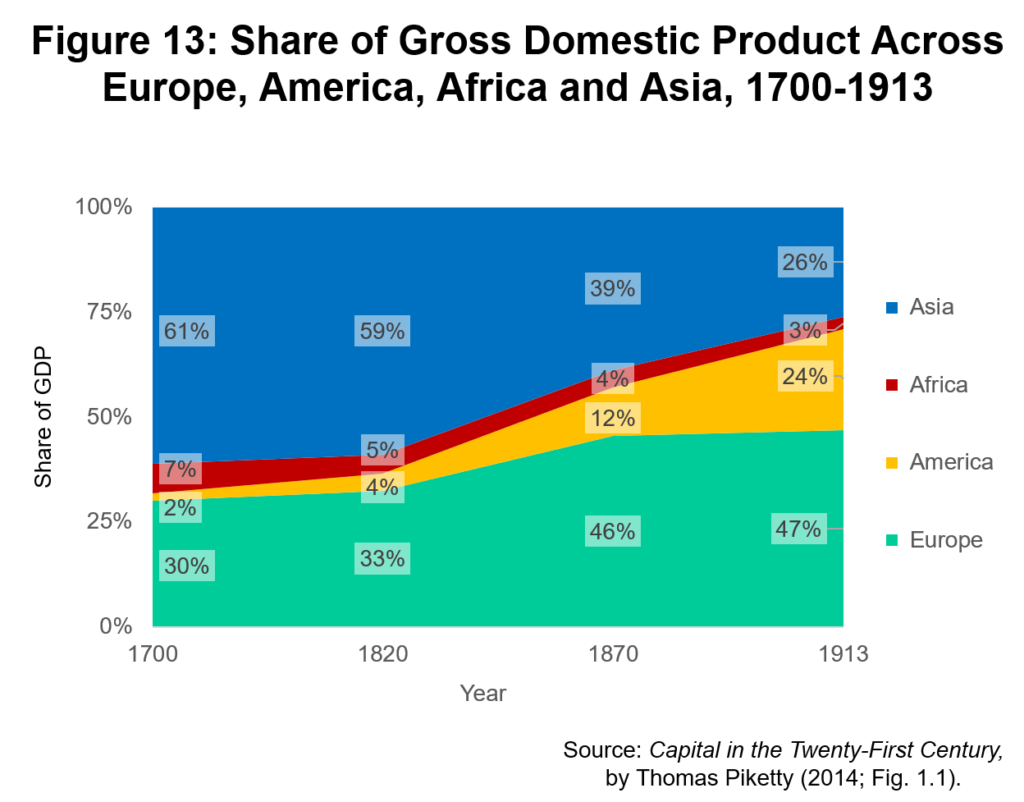
Relative to Asia/Pacific and Africa combined, according to Piketty, Europe’s and America’s share of GDP rose from less than a third of the total at the start of the Enlightenment to 58% by 1870, as Figure 13 shows. That share kept rising to nearly three quarters of the aggregate GDP pie for these regions by 1913, just before World War I kicked off. That massive shift in GDP share didn’t happen because the economies of Asia/Pacific and Africa went into a tailspin. Europe’s and America’s economic output grew much faster in this period, and this partly reflects working class people’s rising wages and increased ability to spend on goods and services (Figure 13 presumably also factors in the impact of colonial plundering by European powers as well as the exploitative effects of slave labor in the American South).7
A separate data set from Capital in the Twenty-First Century makes a complimentary point: as Britain’s economy grew in the 1800s, the associated income gains weren’t enjoyed by business owners, large landholders and the aristocratic class alone. The income split between capital and labor between 1770 and 1910 in Britain, per Piketty et al., is laid out in Figure 14. The capital income share shown in the figure aggregates income from business profit, stock dividends, interest and rents. That’s mostly the incomes enjoyed by the wealthy. Labor’s income share reflects the money going to workers or employees. While the income split vacillated in this period, it wound up where it started, with 36% of income all going to the capitalists. Capital’s share rose in the mid-1800s in Britain, but trended back down circa 1890, so labor’s share of income remained in the 57% to 67% range over this 140-year span, according to Piketty et al.8
There’s no reason to think Britain was an odd duck in the 1800s. The more limited but comparable data from France suggests a similar trendline played out.9 Taken together, figures 13 and 14 strongly suggest that standards of living went up dramatically for most workers in Europe and America in the 19th century, although it’s certainly true that business executives, investors and the aristocratic class shared in the wealth gains.

There were of course plenty of desperately poor people in the U.S. and Europe in the 1800s. Little or no public social safety net existed in this period for starters. If you were born or became poor, you could get stuck in a rock bottom miserable state and never budge. Remember, however, that the norm for most people before the Industrial Revolution was subsistence farming or serfdom (or slavery). Stated slightly differently, grinding poverty remained “a thing” before and through the Industrial Revolution. The middle class, or bourgeoise, expanded significantly in the 1800s, a clear sign of rising income and wealth in the midsection of these societies. Those middle-class families had no interest in going back to pre-Industrial Revolution norms.
The corporation came into its own in England and America in the 1800s. The modern corporation, these newly minted “artificial persons”, gained the ability to issue tradable and resellable shares (giving rise to stock markets) and the legal advantage of limited liability (investors’ downsides were limited to their investments in a company).10 Those three things – personhood rights, the issuance of resellable shares, and limited liability protections – moved the corporate structure from the sidelines of society to center stage over the course of the 19th century. As noted in Chapter 2, there were about 4.8 million corporations in the U.S. that reported assets to the IRS in the 2010-2013 period. North Korea still has none.11 There may be no greater barometer of the relative health, stability and resiliency of a nation than the number of profitable companies per capita that call that nation home.
The rise of larger and increasingly lucrative businesses in the 1800s led to the lionization of their executives and major investors/shareholders. The affection, adoration and sympathy of many Europeans and Americans swung towards nouveau riche business executives in this period. Adam Smith’s invisible hand was working its magic, and it mainly rubbed off on businessmen who got really rich. Smith also warned us not to put these lucky few on too high of a pedestal.
“What pity, we think, that any thing should spoil and corrupt so agreeable a situation! We could even wish them immortal,” wrote Smith in The Theory of Moral Sentiments. “Great King, live for ever! is the compliment, which, after the manner of eastern adulation, we should readily make them, if experience did not teach us its absurdity.”12 Hero worship of rich and seemingly happy, self-confident business leaders is an understandable human response. They must have done something right, no? Is it wise to assume, though, that these captains of industry also know better than monarchs or church leaders how to run a country? The Enlightened Adam Smith said pump the brakes.
One of America’s first self-described libertarians, Albert Nock, believed that the socioeconomic power shift away from royalty, aristocrats and the church and toward business execs and wealthy investors was largely completed in England by 1800. In 1935’s Our Enemy, the State, Nock describes this shift and goes on to suggest that it was in business leaders’ interests to coopt the State’s (the national government’s) power in a manner that caused it to act on behalf of business interests. Wrote Nock:13
When the town-dwelling merchants of the 18th century displaced the landholding nobility in control of the State’s mechanism, they did not change the State’s character; they merely adapted its mechanism to their own special interests, and strengthened it immeasurably. The merchant-State remained an anti-social institution, a pure class-State, like the State of the nobility…
[The merchants and financiers]…saw the attractive possibilities of production for profit, with the incidence of exploitation gradually shifting to an industrial proletariat. The saw also, however, that to realize all these possibilities, they must get the State’s mechanism to working as smoothly and powerfully on the side of “business” as it had been working on the side of the monarchy, the Church, and large-holding landed proprietors.
Whether one thinks the main sea change in socioeconomic power between monarchies and church authorities on the one hand and business interest on the other took place in 1700s or 1800s in the UK, what’s beyond dispute is that America’s approach to governance, as captured in the U.S. Constitution and in various state constitutions, was dramatically more decentralized than how the UK (and other European powers) functioned at that point. Broad-based democracy was new and untested ground, at least since the days of Ancient Greece, and a range of opinion on the merits of the experiment existed.
♦
The second U.S. president, John Adams, in a letter to James Madison (the fourth president) in 1817, came down closer to Macaulay on the issue of voting rights than perhaps most Americans realize. “It is hard to say that every man has not an equal right; but admit this equal right and equal power, and an immediate revolution would ensue. In all the nations of Europe, the number of persons who have not a penny, is double those who have a groat [a silver coin worth four pennies]; admit all these to an equality of power, and you would soon see how the groats would be divided.” Adams thought that if America went straight to universal suffrage that the unwashed, impoverished masses (mostly subsistence farmers and slaves in the South) would assume that governance power, divvy up the money much more equally than how Europe did it, and leave America in chaos as its initial crop of aristocratic families (i.e., large landowners and plantation owners) was decimated.
Adams was the first and last Federalist president. He was opposed by Thomas Jefferson, the third president, and the Democratic-Republican Party, which was more amenable to socioeconomic power decentralization. The Federalists preferred power in the federal government’s hands, in large part, so that the property of America’s aristocratic class could be protected.14 That was the battle line between Adams and Jefferson. Jefferson’s Democratic-Republicans wanted those groats more equally divided and that involved ceding more substantive rights and powers to the states and to the people living in them.
Many in Jefferson’s own party were also wary of extending the franchise too far too fast in the early 1800s. The issue of how power dynamics should play out in the slave states was especially sensitive and thorny. John Randolph, a fellow Virginian, held that Jefferson’s expansive vision of democracy, which definitely included all white adult males and that sometimes implied that universal suffrage was the long-term aim, was incredibly rash.15 Randolph wanted the vote restricted to wealthy, landowning, adult white males. Mocking Jefferson, said Randolph, “No, sir, a Negro boy with a knife and a tallystick, is a statesman complete in this school.”16 Letting black people vote (free or enslaved) as well as giving poor whites the franchise was a huge threat to social stability in Randolph’s view.
Another prominent Democratic-Republican, the South Carolinian John C. Calhoun, who eventually became vice president circa 1830, argued that majority rule may very well turn despotic. An “uncontrolled numerical majority, is but the absolute and despotic form of popular governments,” Calhoun argued, “just as that of the uncontrolled will of one man, or a few, is of monarchy or aristocracy; and it has, to say the least, it has as strong a tendency to oppression, and the abuse of its powers, as either of the others.”17 The buck of government certainly stops somewhere. Calhoun’s statement papered over his deeper concern, though: that a popular government was likely to produce more equality of outcome than a government controlled by white, male landowners, especially if African-American men were allowed inside the tent.
Calhoun was one of the leading defenders of slavery in the antebellum South. He used Jeffersonian states’ rights arguments in a legal context. Unlike the Federalists, who had faded into the woodwork by 1830, Jefferson wanted that power decentralized, and not just to the level of the state but, ultimately, to the level of every flesh-and-blood adult in his more visionary statements.
Calhoun and the defenders of slavery supported the former and rejected the latter. He maintained that if the “front ranks” of people were held back by the government – the likely result of majority rule – or if governmental policies tried “to push forward the rear into line with the front” ranks of people – another likely result of broad-based democracy – that this would “effectually arrest the march of progress.”18 Calhoun may not have wanted America to crown a king as they did in England, but he was as sympathetic to aristocratic dominion on the state level as any Federalist had been (many of whom he called friends) on the national level. That approach would let slavery stand. America’s initial implementation of democracy was thus quite restricted, but it was still more decentralized than the European governing norms of ~1830. That was the experiment Macaulay and company were predicting would fail.
Defenders of aristocratic and theocratic rule ran into the burgeoning philosophy of Utilitarianism around this same time. Pioneered by the Enlightened English social reformer, Jeremy Bentham (1748-1832), Utilitarians thought that “it is the greatest happiness of the greatest number that is the measure of right and wrong.”19 The goal of well-run organizations was to maximize the well-being, and thus the utility, of as many of its members and the associated resources at its disposal as possible. This approach, Bentham’s research implied, would deliver upsides to both companies and nations. Utilitarianism was a science-backed smackdown of aristocratic governance. It was version 2.0 of the democratic republican philosophy that was equally applicable to countries and businesses, and it began to have a profound effect on public opinion in Europe and America in the 1830s.
Adam Smith and Bentham had corresponded in the 1790s. For markets to reach their maximum potential, as Chapter 2 laid out, they first must contain a vast number of healthy, well-resourced agents who are swimming in a soup of accurate information. Bentham espoused equal rights for women, the abolition of slavery and capital punishment, fought for wider access to education, more spending on sanitation infrastructure, and (in an unpublished essay) called for the decriminalization homosexual acts. Practically all of the Utilitarian’s policy prescriptions would promote or strengthen what is called here the Arrow-Smith ideal’s core tenets.
Nothing about Utilitarianism appealed to kings, aristocrats and church leaders. These centers of power quickly recognized that they stood to lose as the Utilitarians advanced. Utilitarianism implied that socioeconomic leveling, relative to prevailing aristocratic norms, produced better aggregate social outcomes. In some ways it was a UK reflection of America’s democratic experiment, but made applicable to social enterprises at all scales.
The English cardinal John Henry Newman rose to confront the Utilitarian scourge. He had a hard time grasping its infatuation with scientific proofs. Wrote Newman, “Life is for action. If we insist on proofs for everything, we shall never come to action: to act you must assume, and that assumption is faith.”20 Paraphrasing Newman, the historian Russell Kirk added that the Utilitarians’ doubt about everything in heaven and earth was “consummate folly. For Doubt is a surly, envious, egotistic emotion, a bitter denial of everything but the sullen self; and one learns nothing by doubting.”21
The rising tide of business leaders who relied on scientific insights to generate additional profits begged to differ. Most went to church on Sunday mornings but they turned back to the science bench on Monday morning. The Utilitarians started winning. Universal childhood education arrived in the UK and America circa 1850. New York City disposed of “rate bills”, the fees that kids had previously paid to attend school, in 1832. A statewide ban passed in 1867.22 America was the world leader in free (state/local tax-based), “open source” education by 1900. The massive expansion of public schools was driven by popular, grassroots activism.23
Utilitarians were something like sleuths who sought out social superstitions and blindly preserved traditions and they relished challenging them. They wanted the aspects of society that served no purpose, and especially those that held back the masses of people from advancing and prospering, to be rooted out and either improved or excised. They believed Calhoun was wrong: progress accelerated when the top got pulled down and the bottom ranks of people were pulled up, and they brought math, logic and history to the table, not just artful rhetoric. The Utilitarians effectively advocated for lower socioeconomic Gini coefficients across the board.
The rising standard of living that millions of laborers in the U.S. and Europe experienced in the 1800s was adequate proof to them that you could trim the top, put a floor under society, and fatten the middle and still see faster overall economic growth. The popularity of Sir Arthur Conan Doyle’s Sherlock Holmes novels, and the broader rise of the crime fiction genre in the late Victorian Era, can be interpreted as evidence of how widely popular the Utilitarian ideal had become by the late 1800s.24
The New York Stock and Exchange Board was constituted in 1817. A panic in 1837 produced big investors losses, and listed stocks thereafter had to disclose more public information about their finances.25 High-quality markets require high-quality information. The first stocks listed on what would eventually become the NYSE were banks.26
Circa 1820, in Dartmouth College v. Woodward, the U.S. Supreme Court ruled that a corporation was “an artificial being, invisible, intangible, and existing only in contemplation of the law.” Other business forms, such as partnerships and sole proprietorships, typically dissolved when their owners died.27 This legal distinction led to many more businesses choosing or converting to the corporate form. Limited liability laws were passed in England in the late 1800s.28 Corporations and stock markets have gone together like chocolate and peanut butter ever since. As the 19th century wound down, though, America’s laissez-faire attitude towards corporate regulations got sorely tested, was put under the microscope, and was found wanting.
♦
The Civil War cost America dearly in virtually every respect. Early in the war, President Lincoln, the nation’s first Republican president, helped guide the fractured nation’s first progressive income tax as well as an inheritance/estate tax through Congress.29 (Let’s pause to throw a peace sign at the IRS.) After the war, his administration added a capital gains tax to the mix to help get the country get back out of debt and to speed its rebuilding process. Capital gains were taxed at the same rate as earned (or ordinary) income, but it appears that Lincoln’s druthers were that capital gains be taxed at a higher rate than ordinary income. “Labor is prior to, and independent of, capital,” said Lincoln. “Capital is only the fruit of labor, and could never have existed if labor had not first existed. Labor is the superior of capital, and deserves much the higher consideration.”
Lincoln’s post-Civil War progressive tax schemes were largely struck down by the Supreme Court in the early 1870s, but by then the government was back on a firmer fiscal foundation. It wasn’t until the country started racking up big World War I debts that higher and more progressive tax rates made a comeback – and they’d stick around after that.30 Costly wars and higher taxes seem to go together like peanut butter and chocolate too.
From the end of the Civil War to the turn of the 20th century, America’s economy expanded rapidly but also suffered an unprecedented string of booms and busts. Between 1869 and 1890 alone there were 17 recessions.31 Many of these recessions lasted over a year, so the country spent a large chunk of this period in mild or serious pain. The engine of capitalism was sputtering. Most of the downturns were associated with quickly evolving business and financial sector dynamics. Calls for governmental actions that would address the boom and bust cycle got louder.
In 1869, a recession linked to post-Civil War business financing issues was punctuated with a financial panic. Another panic followed in 1873 when a major bank, Jay Cooke, failed, bursting a speculative bubble. New York’s stock market was shuttered. The country didn’t climb out of that recession until 1879, making it longest economic contraction in U.S. history.
The American labor movement began to stir during this downturn because business leaders kept cutting employees’ pay. The Great Railroad Strike of 1877 was something of a coming out party for labor. It was a massive work stoppage for the time, involving 100,000 workers in multiple states. Federal troops, the National Guard, and employer-funded militias were called in to suppress the strikers. A hundred people were dead by the time the dust settled.32
A railroad construction boom helped propel the economy forward from 1879 to 1882. When that boom ended, big job losses ensued. Demand for iron, steel, and related foundry products fell sharply. The associated recession led to yet another financial panic. Two big banks and a prominent investment firm went belly up in 1884.33 The pattern was now clear to anyone who cared to recognize it: boom, recession, stock market crash, a run on the bank, ugly bankruptcies for companies and families. Rinse and repeat. The federal government largely sat on its hands through this period, and when it stirred, it mostly acted to defend capital’s interests. Perhaps Nock had a good bead on State loyalties after all.
The rise of labor unions was an organic and rational response by non-capitalists who wanted more income stability in a seemingly endless sea of boom and bust waves. If the state and federal governments were unwilling or unable to take action to reduce the severity and frequency of painful economic shockwaves on nonfarm workers, it was logical that workers band together to present their common interests to employers in an effort to win guardrail concessions around pay, workplace safety reforms, etc.
The National Labor Union came together in 1866 to see that the needs of skilled workers and craftsmen were better met.34 The Noble and Holy Order of the Knights of Labor debuted in 1869. Founded by a Philadelphian tailor, Uriah Stephens, the Knights of Labor grew to represent the interests of some 700,000 workers in the U.S. and Canada (and eventually in the UK and Australia) as soon as 1886.35 Unions clearly filled an unmet market need. The American Federation of Labor (AFL) was founded the same year in Ohio. By 1925, the AFL served as an umbrella organization that included over a hundred North American unions and brotherhoods; three million workers were members by then.36
The rise of organized labor, a natural corollary of Utilitarianism, was immediately viewed as another threat to aristocratic and monarchal social norms. The terms socialism and communism had been coined by that point. These ideas didn’t make popular inroads in the U.S., however, until they hooked up with the labor movement. The closest Karl Marx ever got to the U.S. was when his daughter, Eleanor “Tussy” Marx, and her unscrupulous partner, Edward Aveling, crossed the pond to go on a speaking tour in 1886 that took them as far west as Kansas City. The Socialist Labor Party made sure that members of the Knights of Labor helped fill the seats.37
America’s experiment with democracy hadn’t failed as Macaulay and company figured it would earlier in the century. The U.S. not only survived the trauma of the Civil War but doubled down on democracy by expanding the franchise to African-American males through the Fifteenth Amendment in 1870. (Macaulay died in 1841, so never saw his prediction founder; had he lived, he might have been pleased to see the former Confederate states passing voting requirement and Jim Crow laws in the 1870s that effectively disenfranchised blacks and a large portion of whites with limited groats.38)
The American poet and editor James Russell Lowell (1819–1891) summarized the shifting concern of the aristocratic class when he wrote the “danger to the existing order of things” isn’t democracy so much as “the Socialism, which may find a fulcrum in it…[W]e can yet, perhaps, do something to correct those methods and influences that lead to enormous inequalities, and to prevent their growing more enormous.”39 Lowell and many others understood that socioeconomic inequalities had increased in the wake of the Civil War and were concerned that the apple cart of America’s elite families might get upset if the trend wasn’t checked.
The Irish-born American journalist, editor and author E.L. Godkin (1831–1902) thought that the popular press had become a meaningful counterforce to aristocratic dominion in the U.S. and Europe. In his 1898 book, Unforeseen Tendencies of Democracy, Godkin concluded that, “The rise of the newspaper press – furnishing materials for an opinion of some sort about public affairs, and the opportunity to say something about them, whether well or ill judged – had a naturally paralyzing effect on aristocratic policy, and would have led to the downfall of aristocratic states even if the French Revolution had never occurred…When every man in the state knew, or thought he knew, what ought to be done, the period of government by small trained minorities had passed away.”40
Godkin grasped that capital had advanced relative to labor by the late 1800s as well, and was concerned that it might lead to big social downsides. “The problem is, I do not hesitate to say, the great problem of government in every civilized country – how to keep wealth in subjection of law; how to prevent its carrying elections, putting its creatures on the judicial bench, or putting fleets and armies in motion in order to push usurious bonds up to par.”41 That assessment reads like a libertarian precursor or a rehashed Tussy Marx speech to the KofL – take your pick.
Despite many painful hiccups along the way, U.S. GDP rose quickly between the end of the Civil War and the start of the 20th century, as Figure 13 showed. A slew of nouveaux riche business executives and investors had emerged and set about gobbling up the competition in this period. With railroads now connecting the nation, more of these acquisitions crossed state lines, a fairly new phenomenon. The noted 20th century American economist and author Robert Lekachman looked back on the 1880s and observed that:42
In market after market, large corporations, cartels, and monopolies weakened or destroyed the fierce competition among sellers which protected buyers from extortion and impelled entrepreneurs to improve quality and increase efficiency. Economists might dream about numerous small enterprises in constant rivalry. The truth was elsewhere. The economics of scale associated with mass production required massive investment and limited the number of producers who could operate profitably.
America’s largest corporations were generating big profits and that drove stock markets higher but these same businesses, according to Lekachman, were also squeezing out or buying suppliers in their “home” market or in adjacent, complimentary markets. The growth of Andrew Carnegie’s steel empire was a case in point. Much of the iron and steel that had built the nation’s railroads and proto-skyscrapers in the Gilded Age came from Carnegie plants in Pennsylvania. He and his partners had spent two decades buying up all manner of related assets, from the mines straight through to shipping finished products.43
Carnegie had little use for organized labor. Sixteen workers died when a plant manager brought in Pinkertons to break up an AFL strike in 1892 (Carnegie had cut their wages, precipitating a strike and lockout).44
The former 19th president, Rutherford B. Hayes, a Republican from Ohio, understood that labor had been getting the short end of the stick relative to capital for years. Hayes scribbled in his diary in 1888 that, “The real difficulty is with the vast wealth and power in the hands of the few and the unscrupulous who represent or control capital. Hundreds of laws of Congress and the state legislatures are in the interest of these men and against the interests of workingmen. These need to be exposed and repealed. All laws on corporations, on taxation, on trusts, wills, descent, and the like, need examination and extensive change. This is a government of the people, by the people, and for the people no longer. It is a government of corporations, by corporations, and for corporations.”45 Yikes.
Hayes may have had an 1886 U.S. Supreme Court decision partly in mind. In Santa Clara County v. Southern Pacific Railroad Co., the court implied that the Fourteenth Amendment’s equal protection clause, for the first time, applied to both corporations and people.46 That was new, and that decision is a breakpoint with the Arrow-Smith ideal in that, unlike natural persons (and animals) who can only consume so much at once and that eventually grow old and die, corporations now had the rights of people but without key constraints that all flesh-and-blood creatures have to deal with, including upper bounds on scale and age. The consequences of these legal changes to the definition of corporations likely alarmed Hayes.
The Republican and Democratic parties, meanwhile, had come full circle and were busy colluding to freeze out third parties from breaking through on the national stage. The Populist Party became a major political force in late 19th century America. The Union Labor Party, the aforementioned Socialist Labor Party and other parties made some noise as well. The effective Democratic-Republican duopoly teamed up to pass ballot statute changes that made it tougher for candidates from other parties to win elections.47
Across the pond, the Irish historian W.E. Lecky both observed and disapproved of what he viewed as America’s emerging plutocracy:48
When triumphant robbery is found among the rich, subversive doctrines will grow among the poor. When democracy turns, as it often does, into a corrupt plutocracy, both national decadence and social revolution are being prepared. No one who pursues modern Socialist literature, no one who observes the current of feeling among the growing masses in the great towns, can fail to perceive their deep, growing, and not unreasonable sense of the profound injustices of life.
Lecky and other observers like him weren’t wrong: American socioeconomic inequities did rise in the late 1800s and, in many respects, approached the level of inequality that existed in Europe. Democracy was by then accepted as a fait accompli by aristocratic forces and was increasingly seen as a model of governance that could be, if it wasn’t already, controlled by wealthy elites. Aristocrats’ threat gauge on democracy was turned down to the brooding contempt setting.
Figure 15 aggregates personal wealth data from the UK, France and Sweden into a European average, and compares it to the U.S., with the wealth share of the top 10% and 1% of individuals broken out for both. According to Piketty and his colleagues, the top 10% of individuals in Europe saw their share of social wealth rise from the low-80s to the high-80s over the course of the 19th century.49 The U.S., meanwhile, played catch up. Its share of top 10% wealth spiked from 58% in 1810 to 81% a century later. These results should be read as directional because these types of national stats were roughly collected at that point, but the overall trend is very likely real.

The Utilitarian torch got passed from Bentham to John Stuart Mill (1806-1873) in late 19th century England. A political economist and parliamentarian, Mill was a fan of science and a staunch advocate of personal liberty, a combination that made him an ardent supporter of universal suffrage. His essay, “The Subjection of Women”, published in 1869 with input from his wife, is an important early work in the suffragette movement.50
British aristocrats once again rallied to defend their crumbling hegemony. Sir James Fitzjames Stephen (1829-1894) went after Mill with particular zeal. The British state had to gird itself against the onslaught of labor unions, feminists and Utilitarians, Stephen believed, or all might be lost in a tempest of sin. “For the mass of men require constraint; they cannot adequately curb their own passions or their own sloth, and so must be compelled to acknowledge the suzerainty of law, which is sanctioned by force”, wrote historian Russell Kirk, summarizing Stephen’s position. “Labor unions or dissenting sects will thrust their particular wills upon the rest of humanity, if government eschews force and supinely accepts the notion that it can employ only discussion in its own defense…Nor is force generally considered evil: rather, it arms the sanction which lies behind whatever good man do. It must be employed to keep men from building anew their Tower of Babel.”51
Stephen, a lawyer and judge by profession, grasped that the days of aristocratic dominion were over by the early 1870s. The twin engines of expansive democracy and capitalism had rendered aristocrats redundant:52
If I am asked, What do you propose to substitute for universal suffrage? Practically, What have you to recommend? I answer at once, Nothing. The whole current of thought and feeling, the whole stream of human affairs, is setting with irresistible force in that direction. The old ways of living, many of which were just as bad in their time as any of our devices can be in ours, are breaking down all over Europe, and are floating this way and that like haycocks in a flood. Nor do I see why any wise man should expend much thought or trouble on trying to save their wrecks. The waters are out and no human force can turn them back, but I do not see why as we go with the stream we need sing Hallelujah to the river god.
Corporate power had increased greatly in Europe and North America by the 1890s. Just as Carnegie grew to manage American steel production like a personal fiefdom, so did John D. Rockefeller grow to dominate oil. His Standard Oil Trust became a textbook example of a Gilded Age monopoly. Rockefeller controlled the vast majority of America’s oil extraction and refining capacity by 1890.53 He’d busily bought up company after company until over 40 large enterprises were under his trust’s umbrella. As oil prices rose, so did the public’s (and many business owner’s) ire.
The federal government finally got off the bench. The result was the Sherman Antitrust Act of 1890. That was the first piece of national legislation that squarely targeted the downsides of near-monopolies. If a company was permitted to buy up all the key providers across its supply chain, as Carnegie had done in steel and Rockefeller had done in oil, they could dictate retail prices since the vast majority of buyers had little effective alternative. As Chapter 2 detailed, that’s the end of efficient markets. It also defeats any claim of advantage that capitalism can cling to relative to alternate modes of commerce. Monopolies stabbed the golden goose. The Sherman Antitrust Act was America’s first attempt to pull that knife back out.
South Africa’s De Beers is another example of classic near-monopoly. Founded in 1888, the company has been a girl’s best friend ever since. Matthew Hart chronicled the history of De Beers’ cartel in his book, Diamond: A Journey to the Heart of an Obsession. The company “kept a tight control of supply” over diamonds even early on, reports Hart, “which gave it mastery of the price. If the price showed signs of weakening, the cartel only had to cut back on the flow of diamonds to the market for the price to recover.”54 De Beers is an example of vertical integration taken to the extreme, which is what Carnegie and Rockefeller did with their respective empires.55
De Beers managed the global price of diamonds for generations based on its chokehold of supply and distribution.56 (The U.S. Department of Justice filed an antitrust case against De Beers after World War II, but it was dismissed because the company had no direct presence on U.S. soil.) “De Beers called the system…’single channel marketing,'” Hart explains, and at “its peak the system controlled 80 percent of the world’s rough. If the diamond price weakened, De Beers cut back the flow of goods into the cutting centers; when the price recovered, it opened the tap again.”57
Extreme corporate vertical integration was put under the microscope and judged problematic in late 19th century America. Armed with the newly minted Sherman Antitrust Act, an unlikely assembly of advocates for the interests of middle class and working poor families, and of small and medium businesses, rolled up their sleeves and got to work. If their science was right, business competition could heat up, socioeconomic Gini coefficients could fall, and GDP could expand rapidly in the coming decades – if their policy vision won out and was put into action.
References